
In my previous post, I defined what I believe shopper marketing should be about in the digital age. Today, I’d like to discuss how to put the theory into practice.
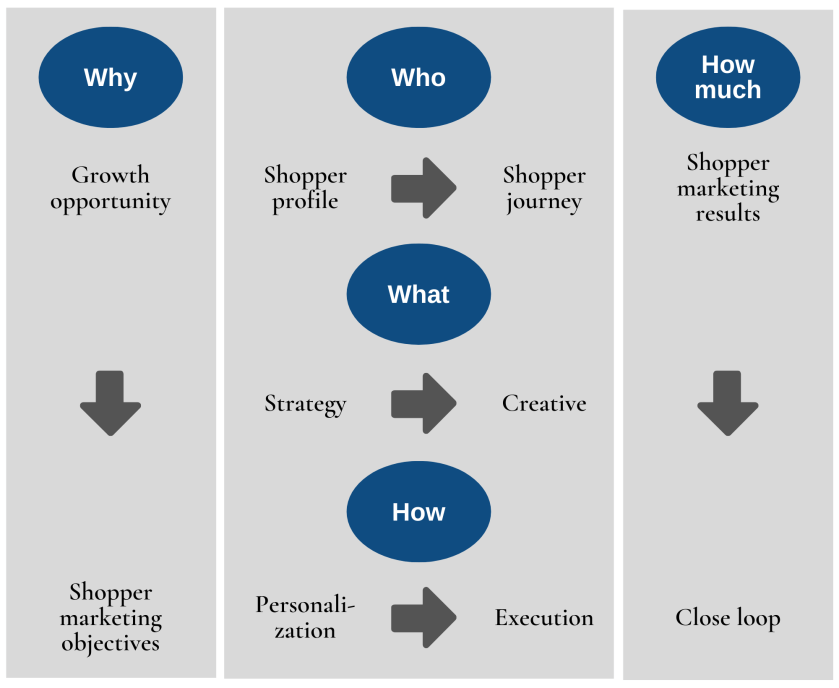
As much as I have a favorite definition for shopper marketing, I have a preferred framework. It is articulated around 5 simple questions: why, who, what, how and how much (3W2H if you like acronyms);
- Why – any shopper marketing activity starts with a business opportunity – or challenge – and objectives;
- Who – the next stage is to immerse yourself into the target audience and analyze how and why people behave the way they behave along the journey;
- What – and, you define the strategy and the creative that can influence those behaviors and try to shift decisions;
- How – then comes the time to plan and execute the shopper marketing activity;
- How much – finally, you need to collect the results and assess the performance of your activity against your objectives. Loop closed.
The answers to the 5 questions can be turned into a sentence that summarizes your shopper marketing activity: we want to [why] among [who] by [what] through [how] to achieve [how much].
Let me give you a simple example: we want to increase the sales of yogurts [why] among light users at the moment they buy food for the family [who] by associating yogurts to a healthy breakfast [what] through a multi-brand campaign in hypermarkets, supermarkets and e-commerce during the back to school period [how] to achieve a 0.5-point increase in penetration [how much]. We could certainly put more details behind each of the stages but I guess you get the point.
You can apply the framework to the two main types of shopper marketing programs or campaigns:
- Manufacturer-centric shopper marketing – in which we connect with the target shopper of a brand owner as a part of a category development initiative or a brand campaign. The audience is the shopper of the brand owner.
- Retailer-centric shopper marketing – in which we connect with the target shopper of a retailer as part of a national commercial campaign or a channel/mission-specific one. The audience is the shopper of the retailer.
[In my forthcoming book, I will present the framework in more detail as well as 10 principles to do great shopper marketing based on day-to-day experience.]

 Think Shopper