
Just before summer, I was having a chat with my colleague Jonathan and we were debating about the emergence of omnichannel retail and its impact on shopper marketing creative.
Unlike traditional advertising that is primarily focused on building awareness and changing brand perceptions from consumers, shopper marketing seeks to communicate to shoppers who are ‘on a mission’. They buy products and services for themselves or for others, in a specific retail format of a specific retailer. Purchases are planned, semi-planned or totally unplanned. Our job is to overcome the barriers that stand between the shopper and the product or service we need to sell. But above all, we have just a few seconds to influence decisions – not thirty. The visual environment at retail is also way more cluttered than a living room. And that makes a big difference in the creative process.
To develop and evaluate creative work, shopper marketers have been traditionally following a three-step approach epitomized by P&G’s ‘stop-hold-close’. Shopper marketing leaders developed their own set of words but they were all based on the same human truth: our cone of vision narrows as we move closer to an object, in that case, a product on a shelf.
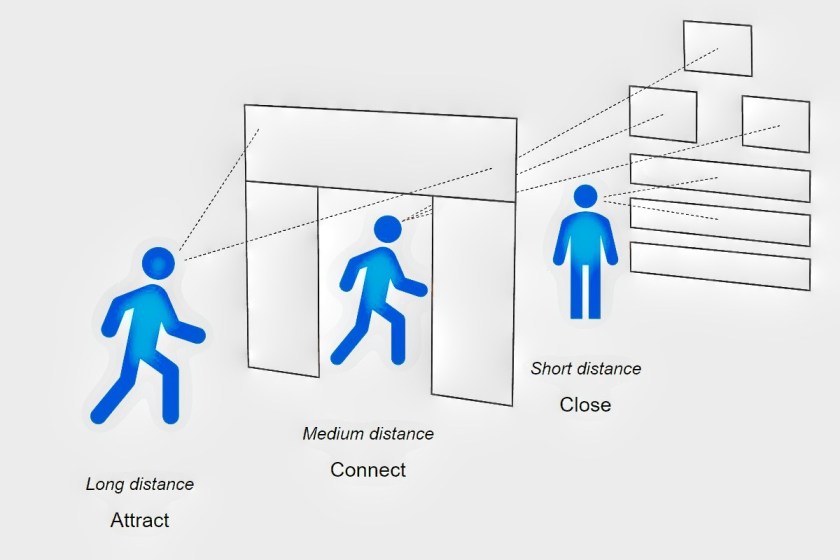
Thousands of successful off-line shopper marketing campaigns have been developed according to the same principles: firstly, from a long distance, you need to capture shoppers’ attention; secondly, from a medium distance, you need to make your product stand out, in a simple relevant way; and thirdly, from a short distance, you need to make shoppers pick your product and put it in their basket.
In the online world, shoppers are also on a mission to fulfill a consumer need but the context is obviously different than in an offline store and it does influence the content. The online journey most often starts with an online search. A list of options is presented to shoppers. They click on a link to know more and ultimately land in front of a digital shelf. They eventually browse the shelf, click and scroll to know more about products before adding the selected product in the basket.
So, the first task of the digital shopper marketer is to take the shopper to the digital shelf through communications that happen before entering the e-commerce site. The second task is to entice the shopper to interact with the category or the product. The third task is to give reasons to the shopper to add the product to the basket. And ultimately pay.
Being successful with the first task requires to achieve a top position in search ranks. For that, shopper marketers must carefully craft the product title and the product description page (in short, the PDP). But they also need to add content like text images, videos that will contribute to search ranking. Most elements will be included in what specialists call an A+ page (a term coined by Amazon, the practice leader and trailblazer in e-commerce). Added value content like A+ pages will also help achieve the second task. For the third one, the key benefit to overcome the barrier, consumer ratings and reviews will also come into play. Together with price and delivery options.
Traditional and digital shopper marketers tend to push different creative frameworks: a variation of “Stop-Hold-Close” for the formers and a simpler “Be available, Be seen, Be sold” for the latter. My view is that in an omnichannel world where lines have blurred, shopper marketers need one single framework. Not two. Here is the omnichannel framework I suggest:
- ‘Attract’ – eg bring the shopper to the shelf – physical or digital – through communications that start way before the moment and the place of purchase. In a highly competitive environment, you need to break through the clutter but also bring the shopper to your retail property, whatever it might be: store, site, app, …
- ‘Connect’ – eg encourage the shopper to interact, consciously or unconsciously, with the category, the product, and the communication, whether physically or digitally. It’s not because the shopper is entering the store that the deal is done. You need to do something that makes the shopper react: look at your product and get closer.
- ‘Close’ – eg give a strong reason for the shopper to put the product in the basket (or the cart). In shopper marketing, engagement is not enough, you need to make the sale. Remove the last barrier to purchase to avoid the shopper to leave empty-handed.
Apply that framework to an omnichannel campaign you are familiar with, you will be amazed to see that it works well with both offline and online shopper communications.
Comments? Thoughts? You know what to do.

 Think Shopper