
As I wrote in my previous post, shopper marketing is about driving incremental sales. Growing is a must-win battle for shopper marketers. But the traditional model is outdated. As coined by the WEF, the world is “sleepwalking” into a significant environmental and social catastrophe, and it’s quite clear we cannot think of growth the same way. No need to be an expert to understand that keeping on encouraging consumption to sell more products is triggering an excessive usage of natural resources and rising levels of carbon emissions, endangering the environment and our societies. A more sustainable and responsible growth path is required.
The uncomfortable truth is that there is little time to change the paradigm. Not me saying it but the UNFCCC, the IPCC, the WMO, and even the WEF. If nothing decisive is put in place within the next few years, the systemic collapse of our civilization will be unavoidable. Despite the increasing coverage of alarming reports, governments and political leaders do not seem to have the ability, and not even the willingness sometimes, to acknowledge the issue and do something about it. We know their names. Fake news, that’s enough.
If governments struggle to take a stand and act, that’s not the case for citizens. For an increasing number of them, sustainability and responsibility are not buzzwords any longer. New habits like recycling, refurbishing, renting, and exchanging are forming; predating behaviors are banished. People are rapidly changing their way of living and consuming, and they expect brands to change too. As reported by consulting firms like Accenture, corporate mission, values, and authenticity play an increasing role in the decisions people make, whether it is connecting with a brand, purchasing a product or a service, or applying for a job.
Meanwhile, more and more businesses follow the path of pioneering B-Corps like Alpro, Natura, or Patagonia and start to respond to those new expectations from customers, employees, and communities. Realizing that sustainability is imperative to thrive, they think and act differently, changing the way they create, produce, and deliver goods. “Executives express a genuine commitment to improving the world,” wrote Deloitte in the “Industry 4.0 readiness report“.
inspiring people to make better choices
Business functions like R&D, manufacturing, and supply chain are evolving their practices, what about shopper marketing? What can shopper marketers do to help solve environmental and societal issues? Time to recall a well-known concept: the purpose. Initially defined at the corporate level, the idea of purpose permeated the marketing world. Having a purpose has many virtues: it increases valuation; it provides a competitive advantage; it drives preference and engagement; it brings companies and teams together. If a corporation or a brand can have a purpose, why not the shopper marketing community? People expect brands to pursue a higher purpose than just selling; for shopper marketers, it could translate into something like ‘inspiring people to make better choices’ rather than ‘trying to sell more.’ No more spam and scam. We would stop churning out more products through mass communications and promotions, while just taking baby steps on sustainability. And instead, we would start encouraging people to buy products more rationally, in smaller quantities but of better quality. Or even telling people not to buy at all, as Patagonia did with its “Don’t buy this jacket” ad back in 2011.
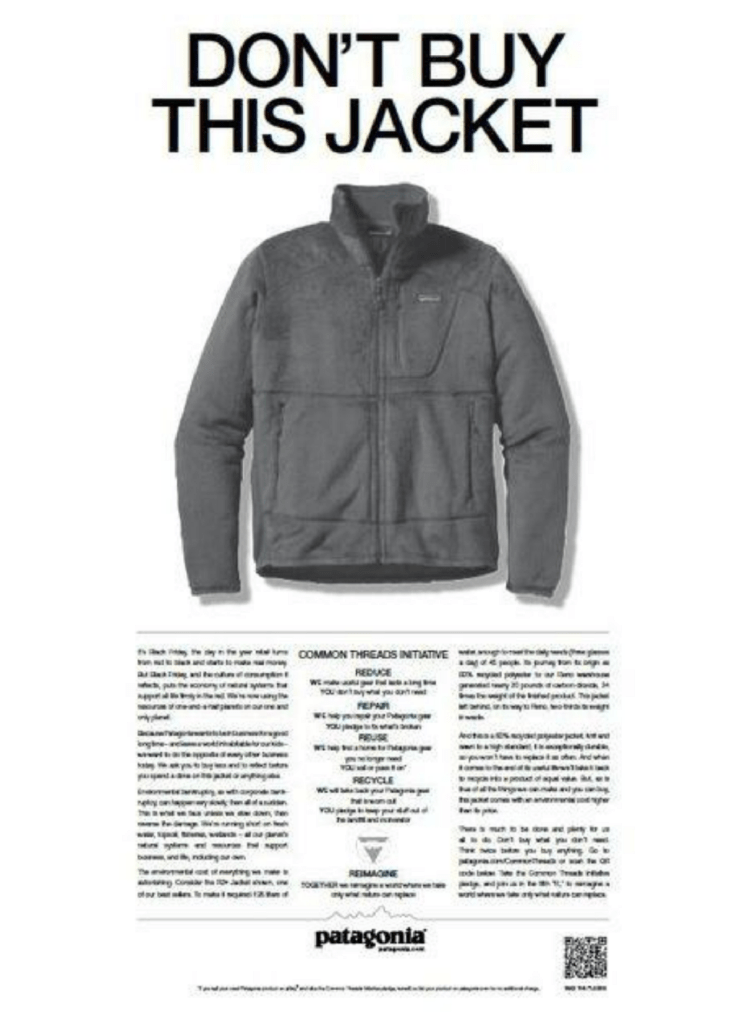
No doubt that doing excellent shopper communications could help advance the Sustainability agenda, but, to have a real impact, shopper marketers would have to gain more authority within companies. To make a difference, we would need to influence decisions across the 4Ps, not just Promotion. Product, Price, and Place are as crucial as Promotion – if not more – to offer products people want to buy, rent, share, or exchange, at affordable and transparent prices, through channels that are mindful of the environment and the people. When strategies, plans, and projects are developed, we should challenge ourselves, our colleagues and our partners, to ensure we market products and services that are doing good for the wallet, the people and the planet.
But having a higher purpose and a bigger scope is not enough. As Peter Drucker once said, if you can’t measure, you can’t manage. And if you can’t manage, you can’t improve. A new approach requires a new measurement framework, not only assessing the effectiveness and efficiency of shopper marketing activities but also considering their environmental and societal impacts. When I was musing over this question, one thought came to my mind: what about bringing together John Elkington’s Triple Bottom Line and Fred Reichheld’s Net Promoter Score? Call it the PSR score – for Profitability-Sustainability-Responsibility score. A set of indexes assessing the impact of shopper marketing decisions against the economic, environmental, and social dimensions. A real conundrum if you consider the heterogeneity of variables, sources, and timeframes to integrate but not something the community could not collectivity crack.
Putting sustainability into shopper marketing is not going to be an easy exercise. It will require courage to face and solve tough issues. It will necessitate commitment and resilience. It will mean investing in the long term rather than focusing on monthly sales. But, at the same time, it will be exciting, galvanizing, and gratifying – particularly for young interns and professionals. As underlined by Rainer Strack from BCG in Davos, “a company purpose is so important for the younger generation; it gives [them] a much better feeling for a company.”
Call to immediate action.
To conclude this article, I genuinely believe that we, as shopper marketers, have a once-in-a-lifetime opportunity — and frankly, a moral obligation — to start doing things differently. It’s true that the size and the abstraction of the challenge are overwhelming. It’s also true that the urgent often drives out the important. But now, it’s important and urgent. As the 16-year-old climate activist Greta Thunberg said at the COP24 audience in Katowice, “You are running out of excuses, and we are running out of time.” And looking into the reports on youth school strikes happening every Friday, she is not the only one asking for immediate action.
Now is the time to move on and help save the world. May the force of Good be with us.

 Think Shopper