
Earlier this year, I wrote that sustainability and responsibility were not buzzwords any longer. Today, I’d like to support this statement with facts. It’s quite clear that people are increasingly mindful of the environmental and social crises. Sustainability and responsibility are starting to trigger new consumer needs as well as to inspire purchase decisions. Traditional currencies of quality, price, and convenience still play a critical role when people are shopping, but brand values and actions have a growing influence on mindsets and behaviors. Over the last two years, several reports from consultants, research companies, and agencies have explored the phenomenon. Let’s do a deep dive.
People are concerned about sustainability.
According to the JWT Sustainability report from 2018, almost everyone claims to be trying to live more sustainably. Eighty-nine percent of people care personally about protecting the planet. Seventy-nine percent are increasingly conscious of their impact on the planet, and fifty-seven percent know the importance of preserving it for future generations. The importance of sustainability is confirmed by PwC’s Global Consumer Insights Survey, which states that very few people (13%) do not have any interest in the topic.
People are changing their way of living. As highlighted by JWT, nearly four out of ten claim they compost waste, two-third that they limit water use in their home and half that they choose more sustainable forms of transport than cars. They avoid the use of plastic – particularly single-use items. But a majority of people think they could probably do more.
JWT reports that sixty percent of the people aim to consume less in general. Reducing their impact on the environment is a key motivation to change their consumption habits for nearly three-quarters of consumers, says Nielsen. It is confirmed by Gartner, who identifies that sixty-one percent of the people practice sustainability because it’s good for the environment. Other motivations uncovered by the consulting firm include being healthier for them and their families, being necessary to sustain the quality of life for future generations, and ultimately making people feel good.
Sustainability matters for shoppers
As PwC found in their Global Consumer Insights Survey, people are not only having good intentions: around one-third of them choose products that help protect the environment; they also buy items with less packaging. Two third of them actively buy local rather than imported goods, and a good half of them buy in bulk to minimize the use of packaging. Several studies highlight that people are inclined to pay higher-than-average prices for high-quality products, respectful of the environment and human rights. But brand owners should be careful: according to Nielsen, nearly half of the shoppers are ready to forgo a brand name to buy environmentally friendly products.
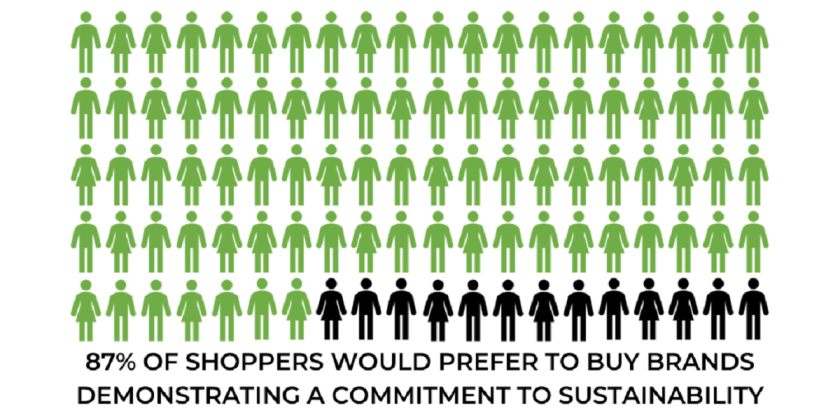
The JWT Sustainability report reveals that more than eighty percent of shoppers are willing to pick a brand showing a better sustainability record or just demonstrating a commitment to sustainability. The values and the actions of companies and brands influence purchase decisions. People can buy or ban companies and brands based on their beliefs and behaviors. For instance, Accenture states that the ethical values and the authenticity of companies drive purchase consideration, and the words, the values, and the actions of their leaders influence buying decisions too (for respectively sixty-two and sixty-five percent of respondents). When companies act in a way betraying what they stand for, people are disappointed and can even stop doing business with those companies. Related to that, they also believe their protest actions, such as boycotting a company or speaking out on social media, can make a difference in how companies behave. Edelman adds that two-third of the people claim they will buy or boycott a brand solely because of its position on a social or political issue.
There are still gaps between intentions and actions.
People are increasingly concerned with sustainability, and they tend to prefer brands and companies that they believe are good for the environment. Recent research published by the NYU Stern Center for Sustainable Business in March 2019 confirms the evolution of CPG shopper behaviors. Between 2013 and 2018, sustainability-marketed products grew five points six times faster than conventionally-marketed products, and three points three times faster than the CPG market. But categories are not created equal: sustainability-inspired purchases are less common in functional categories like detergents. The truth of the matter is that mindsets don’t systematically translate into behaviors. JWT gives indications on the order of magnitude of the gaps: although almost everyone claims they recycle (89%), only half of the people always do (52%); most people say they refuse single-use plastic (85%), but only a few of them do it every time (20%); most people agree that they buy too many clothes (86%) but almost half of them concede they often buy new clothes to keep up with trends in fashion (40%). Along the same lines, the Shopper Explorer study from Havas Paris highlights that a significant proportion of consumers think it’s still possible to keep on consuming like before without damaging the environment (numbers range from 55% in France, 61% in the US and 86% in China). Debunking myths and helping people embrace more sustainable and responsible ways of buying and consuming is critical.
What does it mean concretely? That’s for another post. In the meantime, you can click on the links below to read the full reports mentioned in the article.
- Accenture. Global Consumer Pulse Research. December 2018
- JWT Intelligence. The new sustainability: regeneration. September 2018
- Nielsen. Global sustainability report. November 2018
- NYU Stern Center for Sustainable Business. Sustainable Share Index™: research on IRI USA Purchasing Data. March 2019
- PwC. Global Consumer Insights Survey. March 2019

 Think Shopper