
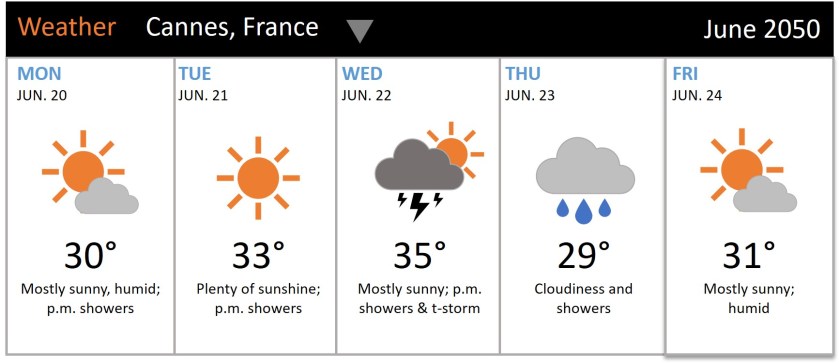
Friday, June 24th, 2050. The Cannes Lions International Festival of Creativity, which is about to close, has been chaotic, at the very least. Record heat wave without a breath of wind during the day, rain showers and thunderstorms in the evening, the 77th annual get-together of the marketing industry has been punctuated by fierce meteorological episodes, disrupting the schedule and the logistics. Wednesday bore the brunt of the extreme weather with a giant mud flow devastating most of the center down to the Croisette Boulevard and the beach. Last but not least, there was no local wine to drink to recover from the emotions! With temperatures rising, the infamous Rosé is now produced in Brittany and Provence is only proposing uninteresting hot red wines. This doom-and-gloom scenario might sound exaggerated, but it’s more or less what scientists predict if temperatures rise by 3°C by 2050.
Thanks to alarming reports and articles from experts, scientists, journalists, writers, opinion leaders and activists, we all know why this might happen: the quest for infinite economic growth is triggering excessive usage of finite natural resources and rising levels of carbon emissions, endangering environments, driving global warming and increasing climate disorders. If we want to avoid this chain reaction, a radical change is needed, now!
As the 2022 edition of the Cannes Festival is about to take place, I’m wondering what the marketing industry is planning to do to help solve the problem. Let me begin with an important disclaimer: I’m not qualified to speak for the community – I’m just an ordinary agency guy with no metal on its shelf – but, after having worked for 3 decades in the industry, I know for sure that we have a responsibility in the acceleration of mass consumption. As I wrote in a previous article, we have been triggering (and sometimes creating) needs to sell more products and services while paying lip service to environmental and social impacts for years. It’s quite clear we cannot continue to work that way: encouraging mass consumption is driving to mass extinction. It’s high time we shift mindset and start to have a positive contribution. Or the ‘35°C and stormy’ weather forecast will become a reality during the Cannes Lions 2050.
Beyond reducing our own environmental and social footprint (plenty of examples are coming to mind but that’s not the topic for today), we must help people acknowledge their impact on the planet and the society (if they have any) and enable them to adopt new regenerative habits! The good news is that around the world and across generations, people are more mindful of the environmental and social issues. The bad news is that people’s good intentions do not systematically convert into actions. There is the infamous intention-to-action gap (or say-do gap, or value-action gap…). According to the latest edition of GlobeScan’s Healthy & Sustainable Living study, nearly fifty per cent of the people have a desire to take care of the environment or help others, but only half of them made major consequent changes to their lifestyle in the last twelve months. Furthermore, conscious consumption has not progressed between 2019 and 2021 globally. A clear signal to revisit our approach to marketing.
Embedding sustainability into marketing
The truth of the matter is that, up until now, sustainable products and services have by and large remained distinct initiatives from the core – a discrete range of a large multinational brand, a new process implemented on a portion of the value chain, a start-up disrupting a category, … I know this is a bit simplistic but probably not so far from reality overall. Today, in June 2022, I guess the trillion dollar question for marketers is how to more effectively close the gaps between what people truly want or need and what people actually purchase. For some categories, regions and social groups, it will mean making sobriety more socially desirable. For others, it will mean making sustainable products accessible and affordable. For all of us, it will be about playing with the 5Ps – purpose, product, price, place and promotion – to holistically embed sustainability into marketing.
How to do it concretely is another burning question which I will not pretend to solve in this article. But I’d like to share some thoughts. While I was progressing in my writing, an old framework (my Wunderman colleagues will remember it) came to my mind: insight, imagination, impact. What a nice combination of words to inspire change:
- Insight: understand what people think about sustainability, what actions they are taking, and why they behave the way they do along the journey; identify potential frictions and roadblocks and define how to overcome them in our categories;
- Imagination: map insights and consult stakeholders to define what we need to change in the way we do marketing across the 5Ps; transform existing ranges, create new ones or both to enable people to find and choose products and services with greater sustainable outcomes;
- Impact: define the journey towards positive impact at scale on people, planet, and profit for our rejuvenated portfolio of products and services; assess progress along the way – are we good enough? are we fast enough? – and close the loop to accelerate impacts.
As an industry, we have the creative power to make the world a better place. Let’s put sustainability at the core of every project and every brief – it’s now urgent and important. And I’m sure the outputs will make superb entries to the upcoming Lions Festivals!

 Think Shopper