
Journeys. What journeys?

Consumer, customer, digital, shopper, …, is there a way to align on a single definition?

Previously on this blog, I have highlighted the importance of the journey to understand people’s behaviors and inform the development of a shopper marketing program. But what journey?

The fact is that the marketing landscape has grown increasingly complex, and paths to purchase are no longer sequential nor linear. The good old sales funnel model in use in marketing for decades is not working anymore (Awareness, Preference, Consideration, Purchase, Loyalty: do you remember?). The cascading funnel “fails to capture all the touchpoints and key buying factors resulting from the explosion of product choices and digital channels, coupled with the emergence of an increasingly discerning, well-informed consumer” said McKinsey & Co in their now-famous article from 2009.

Today, the journey term is well established in the marketing community and even beyond. Nowadays, when you join a meeting, everyone talks about journeys: consultants, creative agencies, media shops, digital giants, and… shopper marketers. But do they really talk about the same thing? Consultants tend to talk about ‘consumer decision journey’, creative agencies about ‘consumer journey’, digital shops about… ‘digital journey’ whereas shopper marketers often use the term ‘purchase journey’.

Embracing the journey as a marketing framework is great but do we really need so many journeys? Probably not. I’d like to offer my point of view on how to bring everyone on the same page – or more literally, on the same map. But let me share a couple of considerations before.

Firstly, marketers realized lately that talking about consumers or shoppers was reductive and somehow flawed. There were no such things as shoppers on one side and consumers on the other: there were people. And often the same people but in different modes – shopping or consuming. Focusing on one or the other was preventing marketers from holistically understanding people’s mindsets and behaviors and communicating with them effectively. They were not connecting insights and actions taken at different stages of the journey.

Secondly, the concept of the ‘consumer decision journey’ has been massively adopted by the industry but in most journey sequels, the word ‘decision’ has disappeared. This simplification is not benign. Journeys do not just distill into an exhaustive list of the touchpoints and messages people may have seen or engaged with. What really matters is to capture the moments during which decisions are made by people, and how they can eventually be influenced. Because it’s only when you understand the role, the relevance and the impact of those moments that you can precisely select the touchpoints and craft the messages. Context and content, not one or the other.

The People Decision Journey

To bring it all together, I’d like to suggest an evolution of the seminal ‘Consumer Decision Journey’ into the ‘People Decision Journey’. The ‘People Decision Journey’ would be a framework mapping all the interactions that happen when people shop to fulfill a want or a need in a category of products or services during their everyday life. A framework capturing the different mindsets and behaviors across the different modes people go through – planning, buying, consuming, using, or reflecting on their purchases. A framework simultaneously providing the macro-view of the key phases of the journey as well as the detailed view of the steps – or micro-moments as proposed by Google – where interactions are happening and decisions are made – online or in real life.
New entries to the shopper marketing dictionary

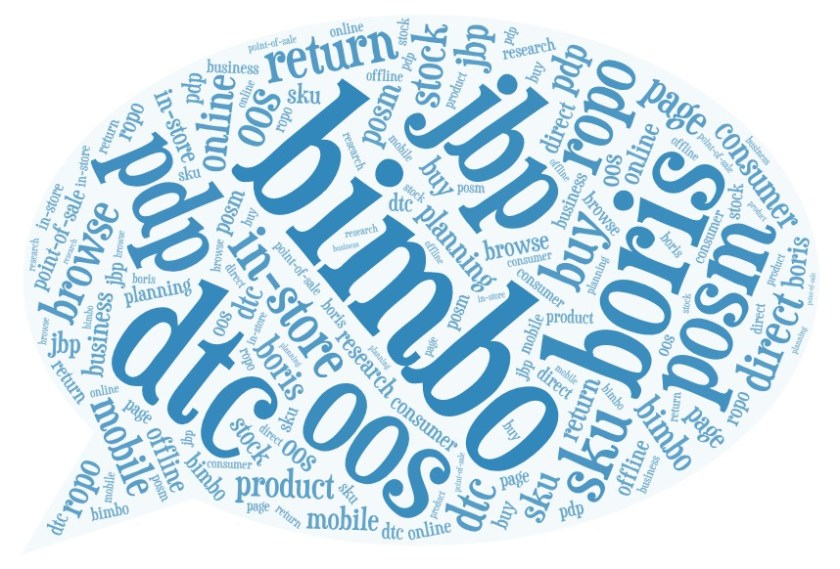
Top 10 acronyms worth knowing.

I was recently attending a meeting and realized how many new terms were used in the conversation. It seems that omnichannel retailing has driven an exponential increase in the number of acronyms and buzzwords in use. Here are my top ten definitions – old and new – to avoid being lost when shopper marketing is discussed.

  • BIMBO: Browse In-Store on Mobile, Buy Online. A variation of showrooming using mobile. Ex. “I browsed the mobile-speaker phones available while I was at FNAC-Darty [popular CE store in my country] and I bought online on my phone”.
  • BORIS: Buy Online Return In-Store. An emerging behavior in omnichannel retailing. Particularly popular among online apparel and footwear shoppers. Ex. “I bought three pair of sneakers online, I returned the ones which did not fit in a store”.
  • CRAP: Cannot Realize A Profit. According to people closed to the matter (eg brand owners who have experienced it), the acronym is used by Amazon to signal the underperformance of a brand on its platform. Ex. “Your brand is CRAP, fix it”.
  • DTC: Direct-to-consumer. A popular trend among manufacturers to experiment with new ways of selling products directly to consumers. Ex. “We decided to connect directly with consumers and cut intermediaries. We tested two approaches: a pop-up store and an online store”.
  • JBP: Joint-Business Planning. A formal collaborative process in which manufacturer and retailer process align objectives, strategies and plans to drive incremental sales. Pioneered by Walmart and P&G in the USA in the eighties. Ex. “We started a joint-business planning initiative with our key supplier to reinvent the beauty category”.
This is what you can hear in a conversation
My top ten shopper marketing acronyms. Word cloud created on wordart.
  • OOS: Out-Of-Stock. A situation where a product is unavailable on a shelf – physical or digital. Ex. “We were frequently out of stock and the retailer told us to fix the problem quickly to avoid being “delisted“.
  • PDP: Product Description Page. the primary webpage for a product, containing all of the relevant information shoppers might need to make a purchase decision. The content also is needed to effectively feed search engine algorithms – critical to succeed on Amazon and e-commerce websites.
  • POSM: Point of Sale Materials. As old as shopper marketing. A generic term referring to all pieces of communication installed in a store. According to Scott Galloway, professor of marketing at NYU Stern School of Business quoted in a Campaign article at the end of last year, voice-based ordering will eliminate the need for POSMs.
  • ROPO: Research Online, Purchase Offline. A shopping behavior also known as webrooming. Ex. “I researched information and compare prices for a bicycle online before ultimately testing it and purchasing it at a brick-and-mortar retailer”. Note that ROPO can also be read as Research Offline, Purchase Online. Confusing, isn’t it?
  • SKU: Stock keeping unit. A number given by a retailer to a specific product, brand, flavor, variety and/or package size – According to my Kantar Consulting colleagues. Ex. “We will launch 3 new SKUs in Spring”.

Shopper marketing in practice

5 essential questions to address.

In my previous post, I defined what I believe shopper marketing should be about in the digital age. Today, I’d like to discuss how to put the theory into practice.

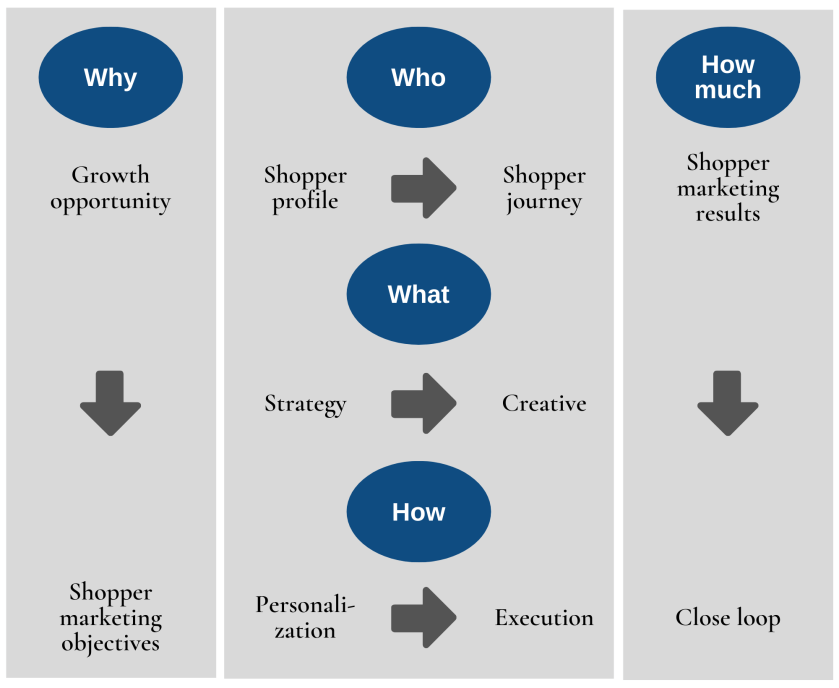
As much as I have a favorite definition for shopper marketing, I have a preferred framework. It is articulated around 5 simple questions: why, who, what, how and how much (3W2H if you like acronyms);

  • Why – any shopper marketing activity starts with a business opportunity – or challenge – and objectives;
  • Who – the next stage is to immerse yourself into the target audience and analyze how and why people behave the way they behave along the journey;
  • What – and, you define the strategy and the creative that can influence those behaviors and try to shift decisions;
  • How – then comes the time to plan and execute the shopper marketing activity;
  • How much – finally, you need to collect the results and assess the performance of your activity against your objectives. Loop closed.

The answers to the 5 questions can be turned into a sentence that summarizes your shopper marketing activity: we want to [why] among [who] by [what] through [how] to achieve [how much].

Let me give you a simple example: we want to increase the sales of yogurts [why] among light users at the moment they buy food for the family [who] by associating yogurts to a healthy breakfast [what] through a multi-brand campaign in hypermarkets, supermarkets and e-commerce during the back to school period [how] to achieve a 0.5-point increase in penetration [how much]. We could certainly put more details behind each of the stages but I guess you get the point.

This is a framework to do great shopper marketing
Shopper Marketing Framework. Meunier E.G., 2018.

You can apply the framework to the two main types of shopper marketing programs or campaigns:

  • Manufacturer-centric shopper marketing – in which we connect with the target shopper of a brand owner as a part of a category development initiative or a brand campaign. The audience is the shopper of the brand owner.
  • Retailer-centric shopper marketing – in which we connect with the target shopper of a retailer as part of a national commercial campaign or a channel/mission-specific one. The audience is the shopper of the retailer.

[In my forthcoming book, I will present the framework in more detail as well as 10 principles to do great shopper marketing based on day-to-day experience.]

Shopper marketing in the digital age

It’s not just about the store anymore.

Defining modern shopper marketing requires understanding the history of both retailing and shopping. Because the discipline is intimately connected to the two.

Since its inception forty years ago or so, shopper marketing has evolved several times to address the changes in the way shoppers behave and how retailers respond to those changes.

Originally, there was retail marketing. And then, in the late 90s, P&G and Walmart created the idea of shopper marketing. At that time, the so-called modern retail was booming and people were visiting large format stores to fulfill all of their needs. Shopper marketing was about creating a campaign like Shakespeare would write a drama: one place, one time, one action; in plain English, the store, the shopping trip, the promotion. The campaign was essentially an ‘event’ to increase sales in large format stores during the weekly fill-up. As defined by P&G, success would come by stopping, holding and closing at the first moment of truth eg in front of the shelf.

Entering the new millennium, retailing was evolving – and shopping too. Shoppers were diversifying their store choices depending on the occasions and the missions. Large-format stores were still dominant for the regular stock-up trip but other – often smaller – formats like supermarkets and c-stores were capturing a significant share of top-up trips and special trips. Unless conveniently located for the shopper, hypermarkets and supercenters were not the first choices to buy a few missing items. And definitely not the place to buy apparel or sports equipment. I should not forget discounters and clubs challenging them all on price and convenience. The competition was fierce. Confronted with an increasingly complex environment, shopper marketers developed increasingly sophisticated programs and campaigns. I remember a manufacturer’s shopper toolkit containing hundreds of pages of guidance and assets across dozens of sections to cover all shopping options you could think about – consumption occasions, shopping missions and retail formats.

People can switch to shopping mode anywhere, at any time

Nowadays, in the omnichannel world we live in, occasions, missions, channels, and formats are still essential but shopping has gone more fluid and ubiquitous. With shoppers getting more familiar and confident with e-commerce, new shopping behaviors are emerging. Breaking the boundaries of physical and digital spaces, shoppers hop from one channel to another to facilitate their purchases or get better deals. Shopping spreads across places, ecosystems and moments. The journey can be long or short, the stakes can be high or low, but covering the entire journey is paramount: what triggers the journey in the first place; what happens – or not – during the planning, buying and consuming stages of the journey; and finally, what influences people’s decisions.

I know that some marketers tend to focus – I could say corner – the journey in the buying phase. Wrong idea. Ignoring the planning phase, when the want and need emerge, is a deadly sin. Across many categories, it is the precise moment when people build the initial consideration set. According to a podcast held recently by McKinsey & Co, the battleground for brands is what they call the ‘active evaluation’ phase when people switch to shopping mode and draw upon past experiences, external influences and biases to list brands that could fulfill their wants and needs. Time is accelerating too. Search, planning, selecting, buying, the upper part of the journey is shrinking. “It used to take time to go from research to discovery to awareness all to purchase,” said Facebook’s Sheryl Sandberg at the last dmexco in Cologne “but now, you have digital and mobile that is happening faster than ever”.

Disregarding the consuming – or using – phase, when the want or the need is satisfied, is a fatal mistake too as it reduces the shoppers’ goal to the act of purchase. People don’t purchase without a reason. They shop to satisfy a want or a need, or according to the ‘Job Theory’, they hire a brand to do a job. Knowing how your brand is doing the job and taking on board comments and suggestions from clients and fans is critical. Together with past experience, social media are more than often the most influential source of information for shoppers. We also have to take into consideration the fact that owning is becoming out of fashion in many categories. Think cars: for the younger generation, what matters is the usage, not the ownership yet the success of alternative transportation options. Overlooking the consuming phase also neglects the fact that the purchase journey is shrinking on that end too. For example, buying and consuming food can be delivered in one act, one place, one time. The industry has already coined this kind of place the ‘grocerant’, the simple contraction of ‘grocery’ and ‘restaurant’. Whole Foods is probably one of the most famous examples of ‘grocerant’ I came across so far.

Shopper marketing is about influencing people when they are in shopping mode

In the digital age, the goal of shopper marketing is to influence the decisions people make, when and where they make them. Using again the analogy with entertainment, modern shopper marketing has more to do with the creation of a TV series than a classical drama: multiple locations, multiple times, multiple actions. The desired output is not a campaign but a holistic experience leveraging the entire marketing ecosystem – brand and retail – along the journey. Creative still needs to attract, connect and close, but at the precise moments when and where brands or retailers have a chance to influence people’s decisions.

Before closing this post, I’d like to propose my personal definition of shopper marketing in the digital age: “shopper marketing leverages insights to influence people’s decisions whenever, wherever and however they are shopping”. If we deconstruct this sentence:

  • shopper marketing starts with insights;
  • it talks to people who are shopping to fulfill a want or a need;
  • the goal is to influence decisions;
  • it takes place along the entire journey – not just at retail.

Quite different from the industry definition but times are changing. What do you think?

Shopper marketing or marketing to shoppers?

Let’s talk semantics for a minute.

When you say ‘shopper marketing’, people immediately think about retail, point of sale materials and promotions. That’s simply because the industry has done very little to evolve the definition of the discipline.

Historically, shopper marketing established itself as the operational component of category management in the late 90s. The term was used synonymously with in-store promotion. Over time, the scope of shopper marketing evolved to encompass all activities taking place inside the four walls of a store. Until recently, the term was mostly employed by the marketing industry to describe retail and trade marketing activities. Shopper marketing was focused on increasing sales in a store during the shopping trip. In other words, pushing the right product, at the right price, in the right place with the right promotion. Fairly basic marketing.

But fundamental changes are now challenging the old definition of shopper marketing coined by the pioneers at the end of the 2000s. The fact is that new technologies are radically transforming shopping. People research products, get usage ideas, seek out deals and review the opinions of peers and experts. Not only for big-ticket items but also for everyday products. Through their mobile devices, they can access content and tools to help them organize, simplify and speed up their purchases. Not only at home or at work but also on the go or at retail. In an omnichannel world, shopper marketing is about influencing people wherever, whenever, however, they are shopping. This means delivering the right proposition, with the right value, at the right moment of the journey and in the right way. Yes, the 4 Ps of marketing, but made contemporary. Shopper marketing is marketing. Marketing to shoppers – so to speak people who are in a shopping mode.

So why using the term ‘shopper marketing’ in the subtitle of my blog while ‘marketing to shoppers’ would be more appropriate? Simply because the expression ‘shopper marketing’ having imposed itself, it would be pointless – and a bit presumptuous – to challenge the most commonly used term in the industry. I will, therefore, comply with general use. But whenever you read ‘shopper marketing’ in this blog, don’t associate the term with point of sale materials and promotions but to the broader holistic discipline of ‘marketing to shoppers’.