
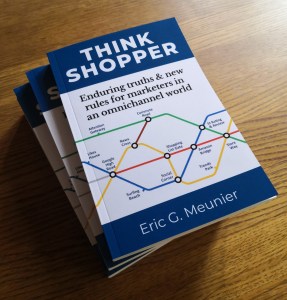
Just published: Think Shopper, the book.

A concise textbook and a how-to guide for marketing students and practitioners.

Back in 2018, I mentioned I was writing a book on shopper marketing. It took longer than expected but I’m happy to announce that it’s now (self)-published.

Think shopper defines what marketing to shoppers is about and introduces a framework to do it well. Illustrated with real-life insights and examples, the book covers the following topics:

Part 1 – What shopper marketing is
• A quick history of the discipline
• The rise of the omnichannel shopper
• A new definition for marketing to shoppers

Part 2 – How to put the shopper into your marketing
• Defining the objective
• Understanding the shopper
• Designing the strategy
• Implementing the plan
• Evaluating the impact

Part 3 – Marketing to shoppers in the new decade
• Four tensions facing marketers
• The sustainability imperative
• Call to action

Think shopper also includes a rich appendix on shoppers, retail stores, and tools as well as a list of my favourite publications, books and websites.

Think shopper. Enduring truths and new rules for marketers in an omnichannel world (full title) is available for purchase on Amazon in ebook and paperback forms. 
P.S.: note I have edited some blog posts to include them in the book, but there is plenty of new and original content.
Shopper marketing in practice

5 essential questions to address.

In my previous post, I defined what I believe shopper marketing should be about in the digital age. Today, I’d like to discuss how to put the theory into practice.

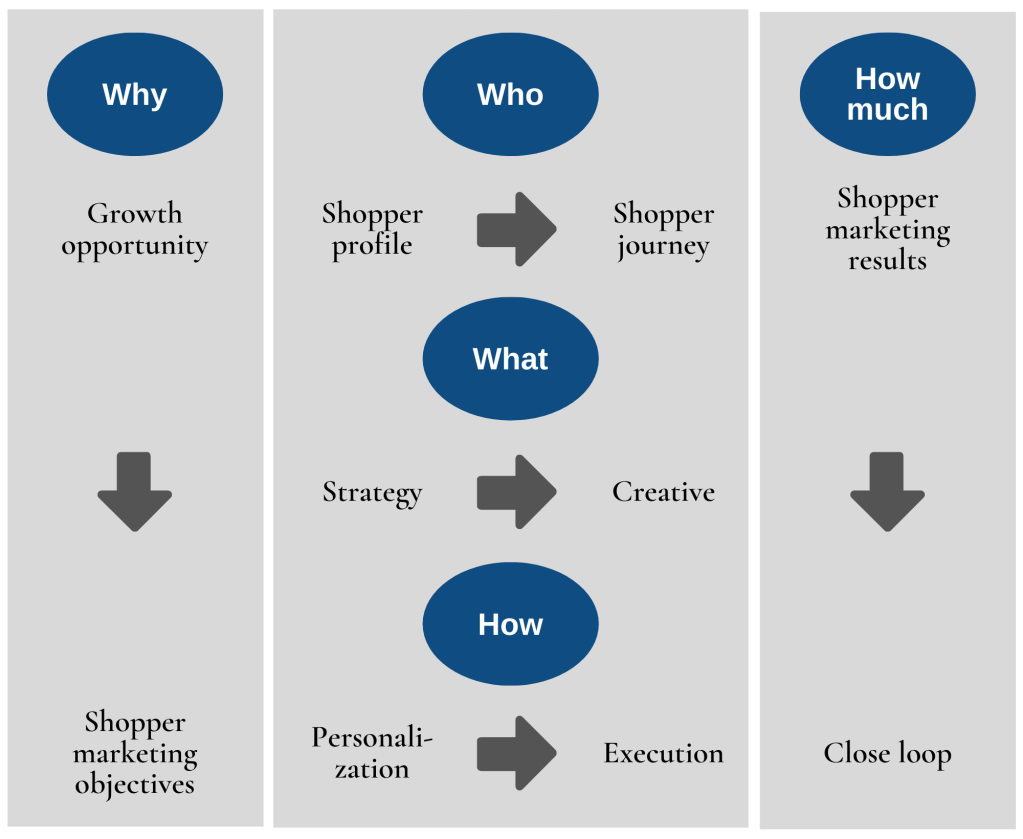
As much as I have a favorite definition for shopper marketing, I have a preferred framework. It is articulated around 5 simple questions: why, who, what, how and how much (3W2H if you like acronyms);

  • Why – any shopper marketing activity starts with a business opportunity – or challenge – and objectives;
  • Who – the next stage is to immerse yourself into the target audience and analyze how and why people behave the way they behave along the journey;
  • What – and, you define the strategy and the creative that can influence those behaviors and try to shift decisions;
  • How – then comes the time to plan and execute the shopper marketing activity;
  • How much – finally, you need to collect the results and assess the performance of your activity against your objectives. Loop closed.

The answers to the 5 questions can be turned into a sentence that summarizes your shopper marketing activity: we want to [why] among [who] by [what] through [how] to achieve [how much].

Let me give you a simple example: we want to increase the sales of yogurts [why] among light users at the moment they buy food for the family [who] by associating yogurts to a healthy breakfast [what] through a multi-brand campaign in hypermarkets, supermarkets and e-commerce during the back to school period [how] to achieve a 0.5-point increase in penetration [how much]. We could certainly put more details behind each of the stages but I guess you get the point.

This is a framework to do great shopper marketing
Shopper Marketing Framework. Meunier E.G., 2018.

You can apply the framework to the two main types of shopper marketing programs or campaigns:

  • Manufacturer-centric shopper marketing – in which we connect with the target shopper of a brand owner as a part of a category development initiative or a brand campaign. The audience is the shopper of the brand owner.
  • Retailer-centric shopper marketing – in which we connect with the target shopper of a retailer as part of a national commercial campaign or a channel/mission-specific one. The audience is the shopper of the retailer.

[In my forthcoming book, I will present the framework in more detail as well as 10 principles to do great shopper marketing based on day-to-day experience.]