Putting the shopper (and the retailer) into innovation

Creating new products that retailers want to sell and people buy.

In an earlier post, I alluded to the importance of putting the shopper – and the retailer – into the innovation process. Today, I’d like to elaborate a bit on this topic.

The fact is that across countries and categories, people have an appetite for new products and services. But big organizations struggle to quickly sense and respond to new opportunities. The result: they fail to put to market innovations that can turn into a sustainable business. According to industry specialists, 9 out of 10 new products launched in the United States fail within 2 years.

For most organizations, innovation is still hit or miss. “Companies know a lot about the characteristics and attributes of their customers, but they don’t understand what causes customers to buy their offerings,” says Clayton M. Christensen and his colleagues from the Harvard Business School. “And without grasping causation, they can’t be sure whether their R&D spending will yield a winning ticket.”

In the book, “Competing against luck”, Christensen et al. propose that companies get to understand causation by asking customers, “What job did you hire that product to do?” Building on Theodore Levitt’s famous drill example, they developed together with an approach to innovation they called the theory of jobs to be done – in short form, the ‘Jobs Theory’.

The ‘Jobs Theory’ states that to create a product or a service, you must first understand why your prospective customers will “hire” it. Then, you must translate that understanding into specifications: “what do I need to design, develop, and deliver in my new offering so that it does the consumer’s job well?”

In other words, you can create a product that perfectly meets the needs of the consumer but it’s the shopper who ultimately buys. And there are multiple barriers between the shopper and a new product or service. If you don’t take purchase barriers into consideration early on, you may design a product everyone loves but nobody buys. Ooops.

Bringing the shopper – and the retailer – into design-thinking

Shopper marketing can help organizations be more successful with innovation, by incorporating the points of view of both the shopper and the retailer into the process. Here are five practical tips based on experience:

  • When you build your cross-functional team to attack market opportunities, make sure the shopper marketing team is represented together with R&D, supply chain, consumer marketing, finance, and external partners.
  • As part of the market immersion, make sure your team spends time in retail – but not just cool places in Shoreditch, Brooklyn or le Marais. Put on comfortable shoes and visit ordinary stores, observe what’s going on, talk to shoppers to find why they buy what they buy. Visit e-commerce sites too.
  • Ask your project team to find out how the needs of the consumer and the shopper could be fulfilled in a new way: core business, intermediaries, new usages. Is there a job we can do better than the products and services people currently use? Is there a gap that can be filled? Are there underserved needs?
  • Think about go-to-market and channel strategy early on. Retailers love innovations as soon as they fit with their strategies. Because unless you plan to sell direct, you will have to partner with a retailer to list, stock and merchandise your innovations in the end. So, understanding what can make them tick is as critical as satisfying consumers and shoppers.
  • Finally, when ideas, concepts, and prototypes are developed, make sure shoppers are part of the test plan. Home tests are great to assess consumer love but they cannot predict shopper purchase. Do a real market test in a few physical stores or a ‘smoke test’ online. Results will be a better indicator of future sales than purchase intent.

Putting the shopper at the core can help design and deliver new products and services that retailers want to put on their shelves and shoppers in their carts. If you do so, you are likely to hit higher success rates for your new product and service introductions. Which means you build a bigger business, and faster. And ultimately a better ROI of the innovation spend.

[This post is the current state of a reflection that started a year ago as I was working on a breakthrough innovation project for a major FMCG company. Thank you Julie, Philippe, Shantanu and Tomas for giving me the opportunity to participate in this project]

Journeys. What journeys?

Consumer, customer, digital, shopper, …, is there a way to align on a single definition?

Previously on this blog, I have highlighted the importance of the journey to understand people’s behaviors and inform the development of a shopper marketing program. But what journey?

The fact is that the marketing landscape has grown increasingly complex, and paths to purchase are no longer sequential nor linear. The good old sales funnel model in use in marketing for decades is not working anymore (Awareness, Preference, Consideration, Purchase, Loyalty: do you remember?). The cascading funnel “fails to capture all the touchpoints and key buying factors resulting from the explosion of product choices and digital channels, coupled with the emergence of an increasingly discerning, well-informed consumer” said McKinsey & Co in their now-famous article from 2009.

Today, the journey term is well established in the marketing community and even beyond. Nowadays, when you join a meeting, everyone talks about journeys: consultants, creative agencies, media shops, digital giants, and… shopper marketers. But do they really talk about the same thing? Consultants tend to talk about ‘consumer decision journey’, creative agencies about ‘consumer journey’, digital shops about… ‘digital journey’ whereas shopper marketers often use the term ‘purchase journey’.

Embracing the journey as a marketing framework is great but do we really need so many journeys? Probably not. I’d like to offer my point of view on how to bring everyone on the same page – or more literally, on the same map. But let me share a couple of considerations before.

Firstly, marketers realized lately that talking about consumers or shoppers was reductive and somehow flawed. There were no such things as shoppers on one side and consumers on the other: there were people. And often the same people but in different modes – shopping or consuming. Focusing on one or the other was preventing marketers from holistically understanding people’s mindsets and behaviors and communicating with them effectively. They were not connecting insights and actions taken at different stages of the journey.

Secondly, the concept of the ‘consumer decision journey’ has been massively adopted by the industry but in most journey sequels, the word ‘decision’ has disappeared. This simplification is not benign. Journeys do not just distill into an exhaustive list of the touchpoints and messages people may have seen or engaged with. What really matters is to capture the moments during which decisions are made by people, and how they can eventually be influenced. Because it’s only when you understand the role, the relevance and the impact of those moments that you can precisely select the touchpoints and craft the messages. Context and content, not one or the other.

The People Decision Journey

To bring it all together, I’d like to suggest an evolution of the seminal ‘Consumer Decision Journey’ into the ‘People Decision Journey’. The ‘People Decision Journey’ would be a framework mapping all the interactions that happen when people shop to fulfill a want or a need in a category of products or services during their everyday life. A framework capturing the different mindsets and behaviors across the different modes people go through – planning, buying, consuming, using, or reflecting on their purchases. A framework simultaneously providing the macro-view of the key phases of the journey as well as the detailed view of the steps – or micro-moments as proposed by Google – where interactions are happening and decisions are made – online or in real life.

New entries to the shopper marketing dictionary

Top 10 acronyms worth knowing.

I was recently attending a meeting and realized how many new terms were used in the conversation. It seems that omnichannel retailing has driven an exponential increase in the number of acronyms and buzzwords in use. Here are my top ten definitions – old and new – to avoid being lost when shopper marketing is discussed.

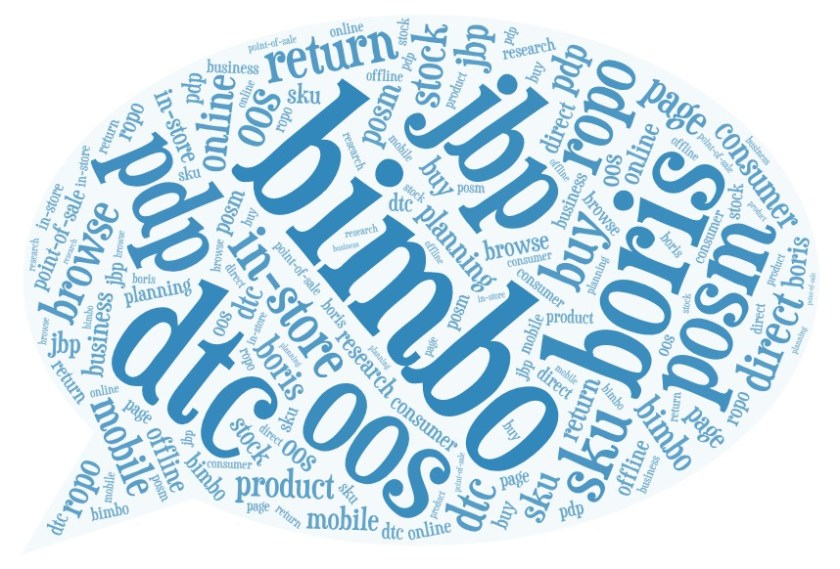
  • BIMBO: Browse In-Store on Mobile, Buy Online. A variation of showrooming using mobile. Ex. “I browsed the mobile-speaker phones available while I was at FNAC-Darty [popular CE store in my country] and I bought online on my phone”.
  • BORIS: Buy Online Return In-Store. An emerging behavior in omnichannel retailing. Particularly popular among online apparel and footwear shoppers. Ex. “I bought three pair of sneakers online, I returned the ones which did not fit in a store”.
  • CRAP: Cannot Realize A Profit. According to people closed to the matter (eg brand owners who have experienced it), the acronym is used by Amazon to signal the underperformance of a brand on its platform. Ex. “Your brand is CRAP, fix it”.
  • DTC: Direct-to-consumer. A popular trend among manufacturers to experiment with new ways of selling products directly to consumers. Ex. “We decided to connect directly with consumers and cut intermediaries. We tested two approaches: a pop-up store and an online store”.
  • JBP: Joint-Business Planning. A formal collaborative process in which manufacturer and retailer process align objectives, strategies and plans to drive incremental sales. Pioneered by Walmart and P&G in the USA in the eighties. Ex. “We started a joint-business planning initiative with our key supplier to reinvent the beauty category”.
This is what you can hear in a conversation
My top ten shopper marketing acronyms. Word cloud created on wordart.
  • OOS: Out-Of-Stock. A situation where a product is unavailable on a shelf – physical or digital. Ex. “We were frequently out of stock and the retailer told us to fix the problem quickly to avoid being “delisted“.
  • PDP: Product Description Page. the primary webpage for a product, containing all of the relevant information shoppers might need to make a purchase decision. The content also is needed to effectively feed search engine algorithms – critical to succeed on Amazon and e-commerce websites.
  • POSM: Point of Sale Materials. As old as shopper marketing. A generic term referring to all pieces of communication installed in a store. According to Scott Galloway, professor of marketing at NYU Stern School of Business quoted in a Campaign article at the end of last year, voice-based ordering will eliminate the need for POSMs.
  • ROPO: Research Online, Purchase Offline. A shopping behavior also known as webrooming. Ex. “I researched information and compare prices for a bicycle online before ultimately testing it and purchasing it at a brick-and-mortar retailer”. Note that ROPO can also be read as Research Offline, Purchase Online. Confusing, isn’t it?
  • SKU: Stock keeping unit. A number given by a retailer to a specific product, brand, flavor, variety and/or package size – According to my Kantar Consulting colleagues. Ex. “We will launch 3 new SKUs in Spring”.

Retail trends… and fads

How to identify and respond to the true macro forces that really matter for a business.

The 2017-18 retail trend season is ending. Unless you were retired from the world on a deserted island over the last few months, you have been hearing and reading about the trends that are disrupting the retail world. There has been no shortage of articles, reports and even books predicting the adoption of e-commerce, the emergence of voice, the revolution of AI or even the death of stores. Every day, we were bombarded from countless sources with ‘trends’, often coined with fancy names, but not always backed by a deep understanding of people’s behaviors. Those that incorporated behaviors often talked out of both sides of their mouths – with trends diametrically opposing one another without giving a clue on how to deliver against them simultaneously.

In fact, when you review those ‘trends’, you quickly realize that most of them have their opposite, grounded in existing or emerging shopper behaviors. People are adopting e-commerce: true. Voice search is going to grow big: true. Artificial intelligence will revolutionize the retail business: true. But it’s also true that people still visit stores, type search terms on keyboards, or talk to customer service agents or sales assistants – and they will continue to do so for quite some time.

4 tensions facing marketers:

  • Digital vs Physical
  • Convenience vs Exploration
  • Budget vs Premium
  • Curation vs Control

Brand owners and retailers are under extreme tension to fulfill those expanding – and often opposing – expectations. My view is that they can only resolve the tension if they understand precisely what people really want and need in the context of their categories, their channels, and their journeys. By identifying what’s driving people to behave the way they behave at the moment, brand owners and retailers can precisely balance opposing trends – or macro-forces – to ensure they design and deliver the right proposition, with the right value, at the right moment of the journey and in the right way. Yes, the 4 Ps of marketing, but made contemporary.

Digital vs physical

Let’s start with the place – I’d rather say Moment of the journey as indicated in a previous post. Everyone agrees that the rapid adoption of new digital technologies has transformed the relationships people have with brands and the way they shop for them. They research information about products, review the opinions of peers and experts, get usage ideas and purchase online – not only big-ticket items like electronics or travel but also everyday products. Shoppers are also getting more familiar and confident with e-commerce and they shop more often online across a larger variety of categories. True. But at the same time, shoppers keep on visiting stores. And they will continue to do so. Only in stores, people can learn, test, try on products and benefit from personal help and advice from caring associates. Shoppers are also creatures of habit and, despite the success of the digital channels, they keep on entering their usual stores for top-ups or weekly fill-ups. The bottom line is that, for shoppers, there is no such divide as digital vs physical: they blend the two along the path to purchase. They research online, purchase offline; they buy online return in-store; or they browse in-store on mobile, buy online. Shoppers visit stores and sites depending on their wants and needs or the spur of the moment. Retailers need to sense and respond to those wants, needs, occasions, and motivations at every step of the journey to capture a bigger share of shopper wallets.

Convenience vs exploration

The right way – to replace the old P for promotion – is a question that has been stirring up some debate lately: what matters most for shoppers between ‘convenience’ and ‘exploration’? Those who say ‘convenience’ look at voice search as the next big thing in shopping. In a not so distant future, shoppers will be able to fulfill their needs without shopping in a store or an e-store. AI will automatically connect products to needs and self-driving cars will deliver those products directly to shoppers. Those who say ‘exploration’ talk about ‘explorium retail’ to describe the enjoyable experiences that retailers like Selfridges are looking to provide to their shoppers – the term is from Trevor Hardy from the Future Laboratory. Convenience vs exploration: interesting debate for which the true answer is ‘it depends’, mostly on the shoppers’ level of involvement in the purchase. In low involvement categories, shoppers will be happy to delegate the chore of shopping to a machine such as Alexa, Google Home, and their clones. If you are selling one of those categories, be ready to learn how to make it to the shopping list of an algorithm! On the opposite side of the spectrum where involvement is high – so does the price to pay – retailers will have to work hard to delight demanding shoppers with well-crafted experiences that go well beyond the transaction. If you are operating in such markets, make sure some of your executives come from the entertainment industry. Having said that, when the sales season starts, it’s neither convenience nor experience, it’s just bargain and price.

Budget vs premium

Delivering the right Value – not just price – is deeply rooted in occasions, needs, and motivations. The tension between offering budget or premium products reflects on a behavior that has been observed for quite some time but recently reinforced by the expansion of categories as well as retail formats: smart shopping. On the one hand, people monitor their spend. They are saving on commodity purchases at their habitual supermarket – retailers have established the idea that value does mean cheap with their private label brands. Or they go the extra mile to visit a discounter or a warehouse club. Value retailers such as Lidl and Aldi have dramatically improved the shopping experience and more shoppers come to their stores. Popularity drives normalization, and normalization drives adoption. On the other hand, shoppers indulge themselves with premium offerings. They spend their disposable income – or the savings they make on commodity purchases – to indulge or pamper themselves with luxury food, personal care, clothes, home equipment, and so on. There is no shortage of newcomers – manufacturers or retailers – proposing top quality products or services to cater to demanding shoppers. Smart shoppers spend more and more on the extremes of value and luxury and retailers need to know, category by category, what’s driving their shoppers’ behaviors.

Curation vs control

Finally, the right Proposition – encompassing product but also associated services. As a rule, people expect brands and retailers to provide them with a selection of products and services tailored to their expectations and preferences. Nothing new in that statement, that’s the essence of marketing. But what’s new is that technology is enabling marketers to offer a personalized, individualized proposition. Curation, which was initially a human task, is increasingly supported, when not fully handled, by machines – think Amazon or Netflix algorithms. Powered by supercomputers, brands and retailers gather data about who people are, what they buy, and how they shop. Algorithms relentlessly and tirelessly scan data to help predict what people may want or need. And software programs deliver personalized assortments and recommendations. Brave new world! But what happens when the system derails? When people receive a suggestion to buy something they have just bought for example? Well, they probably wonder whether they should keep on relinquishing personal data to inform such irrelevant propositions. Not to mention the fear of security breaches. The value people place on their personal data is bound to increase, creating an increased desire for privacy and control over personal data. And with initiatives like GDPR coming to fruition, we believe the tension can only exacerbate. [Update: even more so since the Facebook hearings in the US]

To conclude this rather long post, there is no question that dramatic changes are happening in shopping and retailing. Some brands and retailers will die, some will just survive but there will be players, big and small, that will thrive. The winners will not just be in the game, they will resolve the tensions facing them and find their own way to win. Firstly, they will develop a growth strategy articulated around a clear and strong value proposition for their brands or their retail outlets – whatever they might be. They will focus on currencies that really matter to shoppers, not just buzzwords or shiny objects. Secondly, they will associate people and technology to develop targeted, relevant actions that connect with shoppers along their journey. And thirdly, they will relentlessly innovate for their shoppers with the obsession of doing the job better. Putting to market products and services that people not only love but also are willing to purchase and recommend others to buy.

To succeed, thriving brands and retailers will need to turn their data into insights. Lots of insights. About consumers and shoppers, categories and products, channels and formats, from their own data warehouses, or via partners and third parties. Armed with those insights, they will develop a holistic yet granular understanding of people: their profiles of course but also their needs, occasions, missions, beliefs, motivations, behaviors,… They will also uncover opportunities to create new concepts and prototypes they can quickly put in front of shoppers to assess future value. Finally, they will identify, very precisely, how they can influence behaviors along the purchase journey, whether if it is through communications or their associates.

Although speed and agility will be critical, reacting to disruption will not just mean being the quickest but also being the smartest. Playing the marketing game is for the brave, not for the timorous.

[I want to thank my colleague and friend Efrain Rosario for helping me write this article.]

Learnings from journey research experts

Take-aways from two insightful events from late 2017.

As briefly mentioned in an earlier post, in the last quarter of 2017, two global players, McKinsey & Co and Geometry*, who have been looking at journeys for the last eight years or so, broadcasted respectively a podcast and a webinar, to share observations and reflections about their journey research practice. Talking to colleagues and clients, it seems that the two events have been largely unnoticed which is a shame considering the insights they uncovered. Let me share a topline summary.

McKinsey & Co: being in the initial consideration set is critical for success

Looking at data from more than 125,000 consumers in about 30 categories, McKinsey & Co found out that only 3 of the 30 categories were ‘loyalty-driven’, while the other 27 were ‘shopping-driven’. In other words, they demonstrated that loyalty was a myth for a majority of categories. Within those 27 categories, the dominant behavior was ‘switching’: 58% of shoppers were buying a different brand from one purchase cycle to the next. The key conclusion they drew was that it was critical for a brand to feature in the ‘initial consideration set’: 70% of brands were actually chosen out of this short-list. Therefore, the battleground for brands was what they call the ‘active evaluation’ phase when people switch to shopping mode and draw upon past experiences, external influences and biases to list brands that could fulfill their needs.

I don’t disagree with their conclusion but, as a shopper marketer, I’m also interested in the 30% of brands selected later on in the journey. In between the lines, it tells me that activating shoppers along the journey to displace incumbents can generate positive outcomes.

Geometry: the levels of risk and involvement are key variables to segment purchase behaviors

Building on the analysis of 66,000 shopper journeys across 38 categories, Geometry found out that differences between categories and markets were based on the effect of only a couple of variables. The starting point is that no shopper wants to make a bad decision. Against this statement, Geometry identified two criteria that discriminate people’s behaviors: firstly, the level of risk associated with the purchase decision and secondly, the level of involvement in the buying process. When you map journeys against those two axes, three behavioral typologies appear: ‘guesswork’, which is low risk/low involvement; ‘copying’ which is some risk and some involvement; and ‘research’ which is high risk/high involvement. While diverse behaviors can be observed, understanding the dominant behaviors in a category and a market can help shape the overall strategy to meet the needs of the majority of shoppers.

Once again, this is a very interesting finding for shopper marketing: if the two variables above – or proxies – are present in your dataset, you can focus your activation efforts on the main behavior in your category and ultimately increase conversion.

The above paragraphs are only short summaries and I strongly encourage you to read the full transcripts and associated reports.

McKinsey podcast: “Driving business growth by zeroing in on the consumer decision journey“. December 2017.

Geometry webinar: “Shopper marketing: Purchase journeys, behaviors and pre-triggers“. September 2017.

*Disclaimer: Geometry is my employer at the time I’m writing this post but the views I’m sharing are my own and do not represent those of the company.