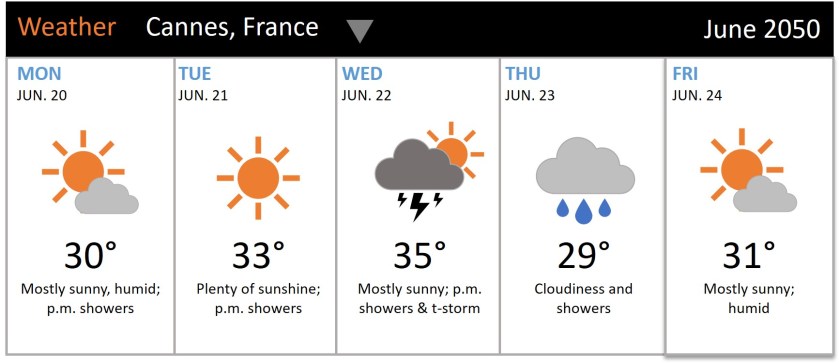
Friday, June 24th, 2050. The Cannes Lions International Festival of Creativity, which is about to close, has been chaotic, at the very least. Record heat wave without a breath of wind during the day, rain showers and thunderstorms in the evening, the 77th annual get-together of the marketing industry has been punctuated by fierce meteorological episodes, disrupting the schedule and the logistics. Wednesday bore the brunt of the extreme weather with a giant mud flow devastating most of the center down to the Croisette Boulevard and the beach. Last but not least, there was no local wine to drink to recover from the emotions! With temperatures rising, the infamous Rosé is now produced in Brittany and Provence is only proposing uninteresting hot red wines. This doom-and-gloom scenario might sound exaggerated, but it’s more or less what scientists predict if temperatures rise by 3°C by 2050.
Cannes Lions 2050 weather forecast (fictional… but not so much)
Thanks to alarming reports and articles from experts, scientists, journalists, writers, opinion leaders and activists, we all know why this might happen: the quest for infinite economic growth is triggering excessive usage of finite natural resources and rising levels of carbon emissions, endangering environments, driving global warming and increasing climate disorders. If we want to avoid this chain reaction, a radical change is needed, now!
As the 2022 edition of the Cannes Festival is about to take place, I’m wondering what the marketing industry is planning to do to help solve the problem. Let me begin with an important disclaimer: I’m not qualified to speak for the community – I’m just an ordinary agency guy with no metal on its shelf – but, after having worked for 3 decades in the industry, I know for sure that we have a responsibility in the acceleration of mass consumption. As I wrote in a previous article, we have been triggering (and sometimes creating) needs to sell more products and services while paying lip service to environmental and social impacts for years. It’s quite clear we cannot continue to work that way: encouraging mass consumption is driving to mass extinction. It’s high time we shift mindset and start to have a positive contribution. Or the ‘35°C and stormy’ weather forecast will become a reality during the Cannes Lions 2050.
Beyond reducing our own environmental and social footprint (plenty of examples are coming to mind but that’s not the topic for today), we must help people acknowledge their impact on the planet and the society (if they have any) and enable them to adopt new regenerative habits! The good news is that around the world and across generations, people are more mindful of the environmental and social issues. The bad news is that people’s good intentions do not systematically convert into actions. There is the infamous intention-to-action gap (or say-do gap, or value-action gap…). According to the latest edition of GlobeScan’s Healthy & Sustainable Living study, nearly fifty per cent of the people have a desire to take care of the environment or help others, but only half of them made major consequent changes to their lifestyle in the last twelve months. Furthermore, conscious consumption has not progressed between 2019 and 2021 globally. A clear signal to revisit our approach to marketing.
Embedding sustainability into marketing
The truth of the matter is that, up until now, sustainable products and services have by and large remained distinct initiatives from the core – a discrete range of a large multinational brand, a new process implemented on a portion of the value chain, a start-up disrupting a category, … I know this is a bit simplistic but probably not so far from reality overall. Today, in June 2022, I guess the trillion dollar question for marketers is how to more effectively close the gaps between what people truly want or need and what people actually purchase. For some categories, regions and social groups, it will mean making sobriety more socially desirable. For others, it will mean making sustainable products accessible and affordable. For all of us, it will be about playing with the 5Ps – purpose, product, price, place and promotion – to holistically embed sustainability into marketing.
How to do it concretely is another burning question which I will not pretend to solve in this article. But I’d like to share some thoughts. While I was progressing in my writing, an old framework (my Wunderman colleagues will remember it) came to my mind: insight, imagination, impact. What a nice combination of words to inspire change:
Insight: understand what people think about sustainability, what actions they are taking, and why they behave the way they do along the journey; identify potential frictions and roadblocks and define how to overcome them in our categories;
Imagination: map insights and consult stakeholders to define what we need to change in the way we do marketing across the 5Ps; transform existing ranges, create new ones or both to enable people to find and choose products and services with greater sustainable outcomes;
Impact: define the journey towards positive impact at scale on people, planet, and profit for our rejuvenated portfolio of products and services; assess progress along the way – are we good enough? are we fast enough? – and close the loop to accelerate impacts.
As an industry, we have the creative power to make the world a better place. Let’s put sustainability at the core of every project and every brief – it’s now urgent and important. And I’m sure the outputs will make superb entries to the upcoming Lions Festivals!
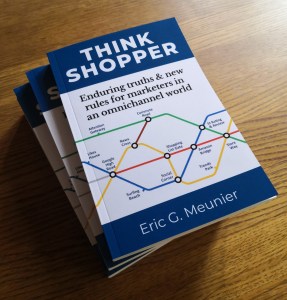
A concise textbook and a how-to guide for marketing students and practitioners.
Back in 2018, I mentioned I was writing a book on shopper marketing. It took longer than expected but I’m happy to announce that it’s now (self)-published.
Think shopper defines what marketing to shoppers is about and introduces a framework to do it well. Illustrated with real-life insights and examples, the book covers the following topics:
Part 1 – What shopper marketing is • A quick history of the discipline • The rise of the omnichannel shopper • A new definition for marketing to shoppers
Part 2 – How to put the shopper into your marketing • Defining the objective • Understanding the shopper • Designing the strategy • Implementing the plan • Evaluating the impact
Part 3 – Marketing to shoppers in the new decade • Four tensions facing marketers • The sustainability imperative • Call to action
Think shopper also includes a rich appendix on shoppers, retail stores, and tools as well as a list of my favourite publications, books and websites.
Think shopper. Enduring truths and new rules for marketers in an omnichannel world (full title) is available for purchase on Amazon in ebook and paperback forms.
P.S.: note I have edited some blog posts to include them in the book, but there is plenty of new and original content.
As I wrote in my previous post, shopper marketing is about driving incremental sales. Growing is a must-win battle for shopper marketers. But the traditional model is outdated. As coined by the WEF, the world is “sleepwalking” into a significant environmental and social catastrophe, and it’s quite clear we cannot think of growth the same way. No need to be an expert to understand that keeping on encouraging consumption to sell more products is triggering an excessive usage of natural resources and rising levels of carbon emissions, endangering the environment and our societies. A more sustainable and responsible growth path is required.
The uncomfortable truth is that there is little time to change the paradigm. Not me saying it but the UNFCCC, the IPCC, the WMO, and even the WEF. If nothing decisive is put in place within the next few years, the systemic collapse of our civilization will be unavoidable. Despite the increasing coverage of alarming reports, governments and political leaders do not seem to have the ability, and not even the willingness sometimes, to acknowledge the issue and do something about it. We know their names. Fake news, that’s enough.
If governments struggle to take a stand and act, that’s not the case for citizens. For an increasing number of them, sustainability and responsibility are not buzzwords any longer. New habits like recycling, refurbishing, renting, and exchanging are forming; predating behaviors are banished. People are rapidly changing their way of living and consuming, and they expect brands to change too. As reported by consulting firms like Accenture, corporate mission, values, and authenticity play an increasing role in the decisions people make, whether it is connecting with a brand, purchasing a product or a service, or applying for a job.
Meanwhile, more and more businesses follow the path of pioneering B-Corps like Alpro, Natura, or Patagonia and start to respond to those new expectations from customers, employees, and communities. Realizing that sustainability is imperative to thrive, they think and act differently, changing the way they create, produce, and deliver goods. “Executives express a genuine commitment to improving the world,” wrote Deloitte in the “Industry 4.0 readiness report“.
inspiring people to make better choices
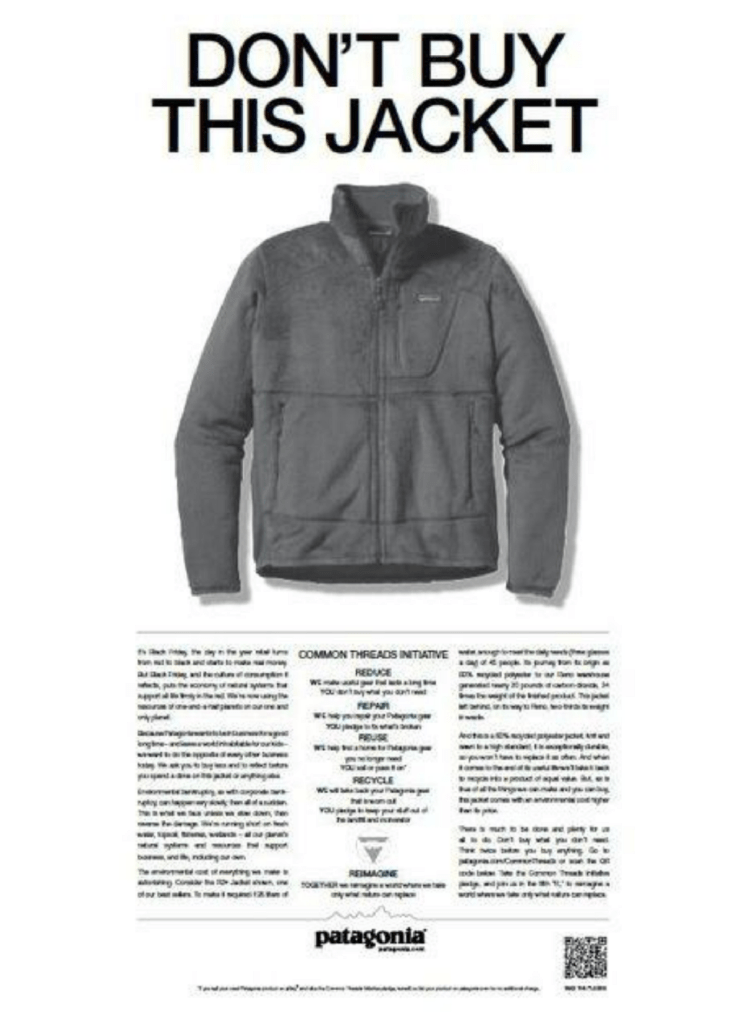
Business functions like R&D, manufacturing, and supply chain are evolving their practices, what about shopper marketing? What can shopper marketers do to help solve environmental and societal issues? Time to recall a well-known concept: the purpose. Initially defined at the corporate level, the idea of purpose permeated the marketing world. Having a purpose has many virtues: it increases valuation; it provides a competitive advantage; it drives preference and engagement; it brings companies and teams together. If a corporation or a brand can have a purpose, why not the shopper marketing community? People expect brands to pursue a higher purpose than just selling; for shopper marketers, it could translate into something like ‘inspiring people to make better choices’ rather than ‘trying to sell more.’ No more spam and scam. We would stop churning out more products through mass communications and promotions, while just taking baby steps on sustainability. And instead, we would start encouraging people to buy products more rationally, in smaller quantities but of better quality. Or even telling people not to buy at all, as Patagonia did with its “Don’t buy this jacket” ad back in 2011.
Patagonia advertisement from the Friday, November, 25, 2011 edition of The New York Times
No doubt that doing excellent shopper communications could help advance the Sustainability agenda, but, to have a real impact, shopper marketers would have to gain more authority within companies. To make a difference, we would need to influence decisions across the 4Ps, not just Promotion. Product, Price, and Place are as crucial as Promotion – if not more – to offer products people want to buy, rent, share, or exchange, at affordable and transparent prices, through channels that are mindful of the environment and the people. When strategies, plans, and projects are developed, we should challenge ourselves, our colleagues and our partners, to ensure we market products and services that are doing good for the wallet, the people and the planet.
But having a higher purpose and a bigger scope is not enough. As Peter Drucker once said, if you can’t measure, you can’t manage. And if you can’t manage, you can’t improve. A new approach requires a new measurement framework, not only assessing the effectiveness and efficiency of shopper marketing activities but also considering their environmental and societal impacts. When I was musing over this question, one thought came to my mind: what about bringing together John Elkington’s Triple Bottom Line and Fred Reichheld’s Net Promoter Score? Call it the PSR score – for Profitability-Sustainability-Responsibility score. A set of indexes assessing the impact of shopper marketing decisions against the economic, environmental, and social dimensions. A real conundrum if you consider the heterogeneity of variables, sources, and timeframes to integrate but not something the community could not collectivity crack.
Putting sustainability into shopper marketing is not going to be an easy exercise. It will require courage to face and solve tough issues. It will necessitate commitment and resilience. It will mean investing in the long term rather than focusing on monthly sales. But, at the same time, it will be exciting, galvanizing, and gratifying – particularly for young interns and professionals. As underlined by Rainer Strack from BCG in Davos, “a company purpose is so important for the younger generation; it gives [them] a much better feeling for a company.”
Call to immediate action.
To conclude this article, I genuinely believe that we, as shopper marketers, have a once-in-a-lifetime opportunity — and frankly, a moral obligation — to start doing things differently. It’s true that the size and the abstraction of the challenge are overwhelming. It’s also true that the urgent often drives out the important. But now, it’s important and urgent. As the 16-year-old climate activist Greta Thunberg said at the COP24 audience in Katowice, “You are running out of excuses, and we are running out of time.” And looking into the reports on youth school strikes happening every Friday, she is not the only one asking for immediate action.
Now is the time to move on and help save the world. May the force of Good be with us.
Shopper marketing is not dead – but it’s time for a change.
The year-end is fast approaching. I felt it was a good time to wrap-up the news and views from the last 12 months.
When you talk about ‘shopper marketing’, even today, at the end of 2018, people think about physical retail, point of purchase materials and sales promotions. That’s simply because the shopper marketing community has done very little to challenge and evolve the traditional definition of the discipline over the years.
Originally, there was retail marketing. And then, P&G and Walmart invented the concept of shopper marketing. Thirty years later, the term is still employed by the marketing industry at large to describe retail and trade marketing activities taking place inside the four walls of a store. For most marketers, shopper marketing is essentially about using the store as a medium to increase sales. Creating a campaign is like writing a Shakespearian drama: one place, one time, one action. As coined by P&G and Coca-Cola, success comes from stopping, holding and closing when shoppers are navigating the store down to the shelf. Thousands of successful shopper marketing campaigns have been developed according to those principles but the world is changing. The relentless march of digital and retail behemoths, such as Google, Facebook, Amazon or Alibaba, is reshaping shopping – and retailing – forever.
With the rapid adoption of digital technologies, shopping is becoming more fluid and ubiquitous, spreading across places, moments and ecosystems. Introducing today’s shoppers, call them the omnichannel shoppers – or in short, the omnishoppers. Omnishoppers research products, get usage ideas, seek out deals and review the opinions of peers and experts. Not only for big-ticket items but also for everyday products. Armed with digital devices, they access content and services to help them organize, simplify and speed up shopping. Not only at home or at work but also on the go or at retail. Most of the shopper habits and behaviors are being “reshaped and replaced at a frantic pace” according to PwC. They are right.
We are all familiar with the ROPO acronym – Research Online, Purchase Offline. People research information and compare prices for an item online before purchasing it at a brick-and-mortar retailer. Interestingly, ROPO can also be interpreted the other way around – Research Offline, Purchase Online. People see, touch, test (or taste) a product in a store but purchase it online later. Webrooming and showrooming are the terms used to describe these prevalent behaviors. But it goes way beyond ROPO. Omnishoppers are adopting e-commerce ‘en masse’. Shopping behaviors are becoming more sophisticated and new acronyms are flourishing: BIMBO, BOPUS, and BORIS to name a few. BIMBO, acronym of Browse In-store on Mobile, Buy Online, is a variation of showrooming using mobile; BOPUS, meaning Buy Online Pick Up in-Store, is the behavior also known as click-and-collect; and BORIS, short form of Buy Online Return In-Store, is an emerging behavior in online apparel and footwear retailing – actually quite costly for those retailers but that’s another story.
Omnishoppers put the classical shopper marketing pillars of place, time and action in question. What is the place of purchase if they hop from one channel to another to facilitate their purchases or get better deals? When is the time of purchase if they shift from reading or watching to buying on almost every communication channel, from the brand website to Facebook, Youtube, and Instagram, in just a couple of seconds? And how can you possibly Stop Hold Close in that context? Omnishoppers also challenge the prevalence of the concepts of the shopping trip, mission, and mindset: if you can buy anytime, anywhere, how can we characterize a shopping trip? How can we assess the level of planning of a purchase? What is the mindset we should take into consideration? And the fact is that we are not watching the final act of the play. Think about voice, another step towards commerce ubiquity.
Over summer, there was no shortage of articles about the unstoppable rise of conversational commerce, powered by voice assistants like Alexa or Google Home. In one of them, Scott Galloway, the famous marketing professor at NYU Stern, was arguing that ordering goods from Alexa was posing a threat to brands by eliminating ‘the need for packaging, design and end caps, all the things that brands have poured billions and decades into perfecting’. Traditional shopper marketing so to speak. A bit provocative as you would expect from Prof. Galloway but thought-provoking.
So, if omnishopping is becoming the norm, I believe shopper marketing must evolve into “omnishopper marketing”. In concrete terms, the discipline needs a new definition, a new scope, and a new framework.
A new definition for shopper marketing
Let’s start with the definition. Even if P&G and Walmart created the idea of shopper marketing in the late 90s, the first authoritative definition for shopper marketing only came from Deloitte and the US Grocery Manufacturers Association in 2007: “All marketing stimuli developed based on a deep understanding of shopper behavior, designed to build brand equity, engage the shopper, and lead him or her to make a purchase.”
In 2008 and 2009, almost all specialists of the discipline went into this definition exercise with varying degrees of success. In 2009, the In-store Marketing Institute and The Partnering Group, joined by specialized consultants, executives from the 10 largest American retailers, as well as representatives from manufacturers and agencies, formed the “Retail Commission on Shopper Marketing”. In April 2010, the Commission released a report proposing a new definition: “Shopper Marketing is the use of insights-driven marketing and merchandising initiatives to satisfy the needs of targeted shoppers, enhance the shopping experience, and improve business results and brand equity for retailers and manufacturers.”
The integration of the journey concept into shopper marketing led to an extension of its scope outside of the sole point of purchase. In 2011, a team of researchers including Venkatesh Shankar and Jeffrey Inman, proposed a more holistic definition: “Shopper marketing refers to the planning and execution of all marketing activities that influence a shopper along, and beyond, the entire path-to-purchase, from the point at which the motivation to shop first emerges through to purchase, consumption, repurchase, and recommendation.”
Today, in 2018, companies around the world tend to use similar sentences to describe shopper marketing. For example, something like “shopper marketing integrates consumer, shopper and retailer insights, to engage shoppers along the path to purchase and win at the key points of decision in order to drive category, manufacturer and retailer sales and build brand equity”.
A good comprehensive definition, with the proviso, of course, that marketers are still in control: they engage at key points of the path to purchase, and if done right, they win. Is this really how it works these days? The truth is that omnishoppers have the power – I know we have been saying that for quite some time, but it is now a reality. Omnishoppers can purchase anywhere, anytime on any device; in marketing terms, people can switch from living mode to shopping mode whenever and wherever they want. Planned or impulse purchases have never been so easy to make. Shifting to competition too. At any point in the journey, competitive brands and retailers are just a few clicks away.
In the omnichannel world we live in, the definition of shopper marketing, and even its name needs a refresh. Here is my view: shopper marketing needs to morph into omnishopper marketing, a modern contemporary discipline that “leverages insights to influence people’s purchase decisions whenever, wherever and however they are shopping to fulfill a want or a need”.
If we deconstruct this sentence,
shopper marketing still starts with insights;
it talks to people who are doing something to fulfill a want or a need;
the goal is to influence decisions related to a purchase;
it takes place across all moments and places – not just at retail.
If we take this to a higher, organizational level, it integrates marketing and commerce to drive engagement and conversion along the shopper journey.
A bigger scope: the omnichannel journey
In the early days, shopper marketing strategies and plans were focused on the point of sale, or as coined by A.G. Lafley from P&G in a letter to shareholders in 2002, on the first moment of truth (FMOT) – the very moment the shopper was exposed to a product for the first time on a shelf. A crucial moment only lasting a few seconds. Either the shopper was finding the product, taking it and putting it in the cart, or he or she was going away to buy a competing product or eventually leaving the store without buying anything.
Entering into the 2010s, the adoption of digital started to challenge the predominance of FMOT. More and more shoppers began to use the web to prepare their shopping trips. They started to search for information about a product, read customer reviews, evaluate different options, compare prices before visiting a store. What Google opportunistically called the “zero moment of truth” (ZMOT) became crucial in most categories.
In 2018, ZMOT and FMOT still exist but there are many more moments of truth across the end-to-end omnichannel journey. The goal of omnishopper marketing is to try to influence shopping and buying decisions when and where they are made. Using again the analogy with entertainment, modern shopper marketing has more to do with the creation of a TV series than a classical drama: multiple locations, multiple times, multiple actions. The desired output is not a campaign but a holistic program leveraging the entire marketing ecosystem across channels, moments and platforms.
Image: the omni(channel) shopper journey. Meunier E.G., 2018.
Sounds great, but how do you do that? Well, before thinking of influencing behaviors and decisions, you have to understand them. Shopper journeys can be long or short, stakes can be high or low, but describing and quantifying them is paramount. Not just the part of the journey taking place at retail or on an e-commerce site, but the end-to-end journey, from the time people are about to shift to the shopping mode to the time their wants and needs are fulfilled.
Some marketers tend to focus on the buying phase of shopper journeys. Wrong idea. Ignoring the early stages of the journey, when the wants and needs emerge, is a deadly sin. As reported in a previous post, McKinsey states it is the precise moment when shoppers build their initial consideration set across many categories. Disregarding the consuming – or using – phase is a mistake too as it reduces the shoppers’ goal to the act of purchase: people don’t purchase without a reason. According to the ‘Job Theory’ initially established by Theodore Levitt, and evangelized more recently by Clayton Christensen and his colleagues, people hire a brand to do a job. Knowing how your brand does its job and taking on board comments and suggestions from clients and fans sounds like a smart idea. Together with past experiences, opinions from peers on social media are more than often the most influential source of information for shoppers.
In concrete terms, understanding shopper journeys requires the collection, integration, and analysis of large amounts of data across categories and products, channels and customers, occasions and missions, mindsets and behaviors. Traditional research methods – ‘shop-alongs’, in-store observations, exit interviews or shopper diaries – do not capture increasingly complex shopping behaviors in a holistic yet granular way. A new approach, pioneered by industry specialists like Geometry, has started to replace the old ones: ‘journey mapping’.
Unique in its methodology, journey mapping recognizes that each person is different. It also acknowledges that a person can behave differently depending on the category, the moment, the mission or the mindset. Journey mapping does not force fit behavior into a prescribed model like a traditional typology or segmentation would do. Journey mapping aggregates individual patterns of behavior to provide a robust understanding of the most common ways people make purchase decisions. What triggers the journey? What steps people are taking, before, during and after the purchase? If they are taking any. What are the moments of truth when and where decisions are made? What influences people – consciously or unconsciously? What are the media or the tools they use at different stages?
Once you understand the role and the importance of those moments of truth, you can start to describe the experience people go through during those moments. Using research or just anecdote, you can identify the pain points or the gaps vs expectations. As soon as experiences are described, pain points or gaps identified, omnishopper marketers can define the actions they need to put in place to shape and transform experiences across journey maps.
But, as already written in a previous post, let’s not fool ourselves: in an omnichannel environment, you cannot manage, or even script the entire experience – there are simply too many combinations and without a doubt, not enough budget in most marketing organizations. What you can to do is to focus on the most dominant journeys. But not only that, concentrate on the precise moments of truths when and where you under-deliver against shopper expectations, under-perform against your competitors or simply want to make a difference – eg do the job better like a start-up would do. Once priorities are established, you must redefine the actions and interactions that need to happen in those particular moments, for those particular journeys. Online or offline, active or passive, machine-to-human or human-to-human. Easier said than done. All the more so that some actions might not be easy to put in place – think about the recommendation of a retail store clerk or the word of mouth on a community website for example.
To influence behaviors and decisions, omnishopper marketers have a toolbox. Initially composed of point of sale materials (POSM), the toolbox now incorporates all the communication vehicles, offline and online, that can be activated across the entire journey. Thus, they can choose to use more traditional shopper marketing tactics like packaging, retail design, in-store communications, and promotions as well as telesales operators and store associates; or digital marketing tools like brand websites, social media, retailer websites, e-commerce marketplaces, mobile apps, location-based marketing, digital POS; and, sooner than later, chatbots, augmented reality and voice search. In most cases, programs associate a combination of traditional and new marketing and commerce tools, leveraging brand, retailer and digital ecosystems, with a dose of test and learn. Considering the complexity and the cost of managing an omnichannel program, it is actually wise to test new scenarios before rolling out at full scale.
The 3W2H framework
Changing the definition and the scope is meaningless if you don’t define how to put the theory into practice. For that, you need a framework. The truth is that the framework for omnishopper marketing is not radically different from the one that shopper marketers have been using so far: you define your objectives, understand your audience, define your strategy, deploy your program and measure the results. In other words, answer 5 simple questions: why, who, what, how and how much (3W2H if you like acronyms). But if the questions remain the same, the answers vary dramatically.
Why – Every marketer on the planet wants to grow. It’s quite logical to have a growth opportunity – and a growth objective – at the inception of every omnishopper marketing program;
Who – Since people can purchase anywhere, anytime, any device, we must define our target audience holistically eg as people and analyze how, when and why they think, feel and behave the way they do;
What – This is when we have to strategize and define all the actions that can influence people’s mindsets and behaviors in favor of our brands along the omnichannel journey;
How – The only strategy omnishoppers see is the execution; in an omnichannel world, it means implementing the program across retail channels, journey steps, and digital ecosystems;
How much – Finally, we need to assess the performance of our program across multiple dimensions: transactions, behaviors, equity, etc. Loop closed.
An entire playbook could be written around those five questions but that’s not the purpose of that article. One point transcending all five questions deserves elaboration though: collaboration. In the omnichannel world, not a single player has all the answers – even the almighty Amazon. Brand owners know a lot about consumers, their wants and their needs, but much less about shoppers; conversely retailers know a lot about shoppers, their behaviors and expectations, but not so much about consumers. Associating the two perspectives is the only way to get a comprehensive and accurate picture of a marketplace, a category or a journey.
Collaboration has been a critical pillar of shopper marketing since the origin. It’s because trade relationships were deteriorating year after year, and trust going down the drain, that Walmart and Procter and Gamble created shopper marketing in the late eighties. Fatigued by the frequency of disputes, the CEOs of both companies met to stop the fight and agree on a better way of working. P&G put a dedicated team in Walmart head office in Bentonville, Arkansas. Walmart and P&G teams started to share data they were previously keeping to themselves. They began to partner on projects benefiting both companies. And it worked. Sales and profits went up. The collaboration was so successful that Walmart asked other manufacturers to adopt a similar way of working. Manufacturers collaborating with Walmart shared the concept with other retailers. Win-win collaboration became the standard practice in North America. Shopper marketing was born.
Over the years, collaboration has experienced ups and downs – and to be fair quite a lot of downs lately. Shifts in people’s behaviors, dramatic changes in the retail landscape and disruption from new digital players have put brand owners and retailers under extreme pressure, challenging the very same idea of win-win collaboration. When times are tough, it’s tempting to squeeze the other party at the negotiation table. But the truth is that this strategy is not going to work with the new elephant in the room: Amazon. To face the challenges they are confronted with, brand owners and retailers need to partner again. They need to “turn the war room into a win room” to paraphrase the seven-point manifesto published by the American Promotion Marketing Association nearly ten years ago.
Like the shopper marketing of the origin, omnishopper marketing requires collaboration. Not only the traditional brand owner-retailer partnership but multifaceted partnerships with digital platforms, data providers and start-ups operating in the same environment. Quite naturally, collaboration must start with a growth strategy, articulated around a clear and strong proposition for shoppers, written down in a joint-business plan – a JBP in short form. A growth strategy aiming to put to market products and services that really matter and bring value to shoppers, not just buzzwords or shiny objects. Secondly, omnishoppers expect a channel-agnostic experience. Therefore, brand owners and retailers need to break down silos to develop targeted, relevant actions across omnichannel journeys. And thirdly, they have to relentlessly innovate for their customers with the obsession of putting to market products and services that people not only love but also want to purchase and recommend to others. Innovation is not an option, it’s an imperative: there are start-ups willing to disrupt your category and become the next Netflix, Chobani or Dollar Shave Club. So, new products, new services, new business models, be productively paranoid and truly innovative or you will join Kodak, Nokia or Toys’R’Us in the pantheon of iconic brands of the past.
Shopper marketing is not dead – but it needs to evolve. To influence omnishoppers, the discipline needs to expand into omnishopper marketing. A new generation of shopper marketing that blends marketing and commerce, physical and digital, human and machine, to form a holistic and data-driven practice covering the end-to-end omnichannel journey. Trailblazers in omnishopper marketing associate existing shopper understanding, retail communications and event management capabilities with new cutting-edge analytics, experience design and digital communication skills to map and transform journeys.
The ultimate measure of success? The experience. The experience resulting from what brands and retailers actually do and how omnishoppers interact with them offline and online. The experience that affects what omnishoppers think about brands and retailers and how they behave. The experience that ultimately provides a competitive edge across all channels and industries. Because in the omnichannel world we live in, people have no boundaries: they evaluate brands and retailers in a truly 360° way. Today’s great experience in a category becomes tomorrow’s expectation across all of them.
One last word: omnishopper marketing is likely to be one of those fields where there will be a steep learning curve. The sooner you start, the more chances you will succeed.
[Geometry is my employer at the time I’m writing this article but the views I’m sharing are my own and do not represent those of my company.]
How to develop and evaluate shopper marketing creative in an omnichannel world.
Just before summer, I was having a chat with my colleague Jonathan and we were debating about the emergence of omnichannel retail and its impact on shopper marketing creative.
Unlike traditional advertising that is primarily focused on building awareness and changing brand perceptions from consumers, shopper marketing seeks to communicate to shoppers who are ‘on a mission’. They buy products and services for themselves or for others, in a specific retail format of a specific retailer. Purchases are planned, semi-planned or totally unplanned. Our job is to overcome the barriers that stand between the shopper and the product or service we need to sell. But above all, we have just a few seconds to influence decisions – not thirty. The visual environment at retail is also way more cluttered than a living room. And that makes a big difference in the creative process.
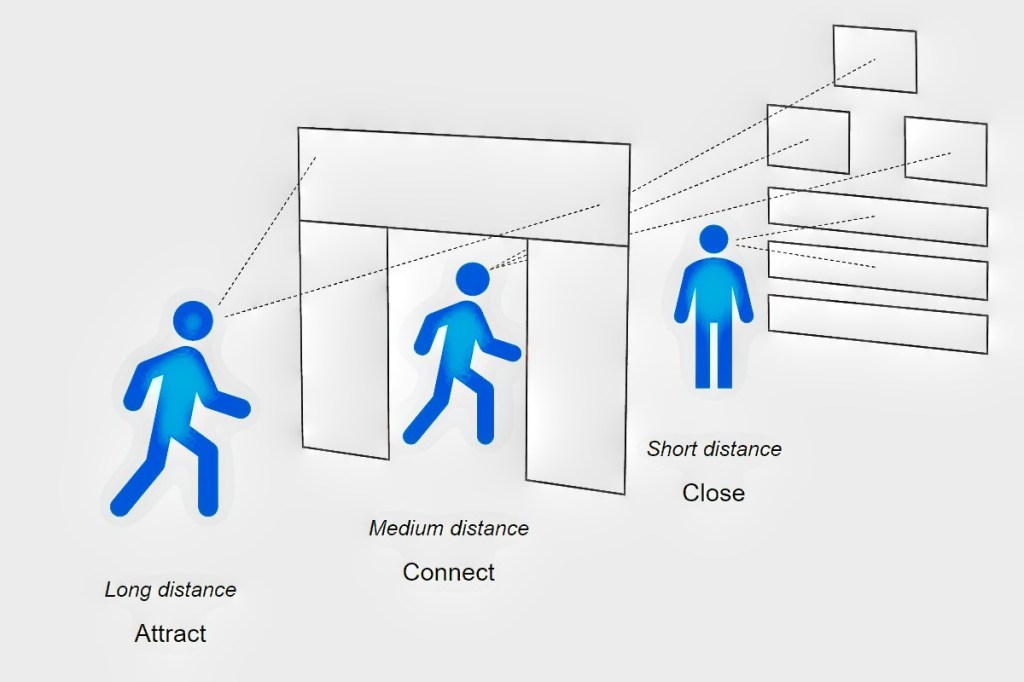
To develop and evaluate creative work, shopper marketers have been traditionally following a three-step approach epitomized by P&G’s ‘stop-hold-close’. Shopper marketing leaders developed their own set of words but they were all based on the same human truth: our cone of vision narrows as we move closer to an object, in that case, a product on a shelf.
Image: the cone of vision.
Thousands of successful off-line shopper marketing campaigns have been developed according to the same principles: firstly, from a long distance, you need to capture shoppers’ attention; secondly, from a medium distance, you need to make your product stand out, in a simple relevant way; and thirdly, from a short distance, you need to make shoppers pick your product and put it in their basket.
In the online world, shoppers are also on a mission to fulfill a consumer need but the context is obviously different than in an offline store and it does influence the content. The online journey most often starts with an online search. A list of options is presented to shoppers. They click on a link to know more and ultimately land in front of a digital shelf. They eventually browse the shelf, click and scroll to know more about products before adding the selected product in the basket.
So, the first task of the digital shopper marketer is to take the shopper to the digital shelf through communications that happen before entering the e-commerce site. The second task is to entice the shopper to interact with the category or the product. The third task is to give reasons to the shopper to add the product to the basket. And ultimately pay.
Being successful with the first task requires to achieve a top position in search ranks. For that, shopper marketers must carefully craft the product title and the product description page (in short, the PDP). But they also need to add content like text images, videos that will contribute to search ranking. Most elements will be included in what specialists call an A+ page (a term coined by Amazon, the practice leader and trailblazer in e-commerce). Added value content like A+ pages will also help achieve the second task. For the third one, the key benefit to overcome the barrier, consumer ratings and reviews will also come into play. Together with price and delivery options.
Traditional and digital shopper marketers tend to push different creative frameworks: a variation of “Stop-Hold-Close” for the formers and a simpler “Be available, Be seen, Be sold” for the latter. My view is that in an omnichannel world where lines have blurred, shopper marketers need one single framework. Not two. Here is the omnichannel framework I suggest:
‘Attract’ – eg bring the shopper to the shelf – physical or digital – through communications that start way before the moment and the place of purchase. In a highly competitive environment, you need to break through the clutter but also bring the shopper to your retail property, whatever it might be: store, site, app, …
‘Connect’ – eg encourage the shopper to interact, consciously or unconsciously, with the category, the product, and the communication, whether physically or digitally. It’s not because the shopper is entering the store that the deal is done. You need to do something that makes the shopper react: look at your product and get closer.
‘Close’ – eg give a strong reason for the shopper to put the product in the basket (or the cart). In shopper marketing, engagement is not enough, you need to make the sale. Remove the last barrier to purchase to avoid the shopper to leave empty-handed.
Apply that framework to an omnichannel campaign you are familiar with, you will be amazed to see that it works well with both offline and online shopper communications.


 Think Shopper